
Anúncios
A sleeping bag is one of the most important pieces of comfort gear you own.
Choose well, and you sleep warm and wake up ready for the day.
Choose poorly, and you spend the night curled up and shivering, counting the hours until sunrise.
Anúncios
The labels can be confusing, though.
Temperature ratings, fill power, mummy versus rectangular, down versus synthetic: each choice changes how warm, heavy and comfortable a bag will be.
Once you understand what each term actually measures, choosing the right bag becomes straightforward.
How a Sleeping Bag Keeps You Warm
A sleeping bag does not create heat.
Your body does, and the insulation traps that heat in countless tiny air pockets.
The thicker and more evenly the insulation lofts, the more warm air it holds,
which is why a bag that has been compressed for months or has become damp feels colder than it should.
The insulation beneath you gets crushed flat by your body weight, so it does very little.
That is why the sleeping pad matters so much.
A bag and a pad work as a system: the bag insulates you from the air, and the pad insulates you from the ground.
Even a warm bag feels cold on a thin, poorly insulated pad.
Reading Temperature Ratings
Many bags are tested with a standardized lab method, often labeled EN or ISO,
which uses a heated mannequin wearing a base layer and lying on a sleeping pad.
The results are expressed as up to three numbers:
- Comfort: the temperature at which a typical cold sleeper can rest comfortably in a relaxed position. This is the most useful number for many campers, especially those who tend to feel the cold.
- Limit or lower limit: the temperature at which a typical warm sleeper can sleep curled up for about eight hours without waking from cold. Many bags carry this number in their name.
- Extreme: a survival rating only, with a real risk of hypothermia. Never plan a trip around it.
Choose a bag with a comfort rating close to the coldest temperature you expect, or a limit rating a little below it.
If you sleep cold, lean toward the comfort number with extra margin.
Ratings assume an insulated pad, dry base layers and a well-fed, rested sleeper; wind, humidity and exhaustion all make you feel colder.
Choosing a Shape and Fit
Shape affects warmth, weight and how free you feel at night.
Less empty space inside means less air for your body to heat.
Mummy
Mummy bags taper from the shoulders to the feet and have a close-fitting hood.
They are the warmest for their weight and pack the smallest, which makes them the standard for backpacking and cold weather.
Restless sleepers may find them confining at first.
Semi-Rectangular
Also called modified mummy or barrel shapes, these bags add room at the shoulders,
hips and knees while keeping much of the efficiency of a mummy.
They suit side sleepers and anyone who shifts around a lot.
Rectangular and Double
Rectangular bags are roomy and often unzip fully into a blanket.
They are comfortable for car camping in mild weather but less efficient in the cold.
Double bags fit two people and are popular with couples at campgrounds.
Quilts
Quilts drop the insulation underneath you entirely, relying on the pad instead, and attach to it with straps.
Many lightweight backpackers use them to save weight, but drafts can sneak in if they are not secured well.
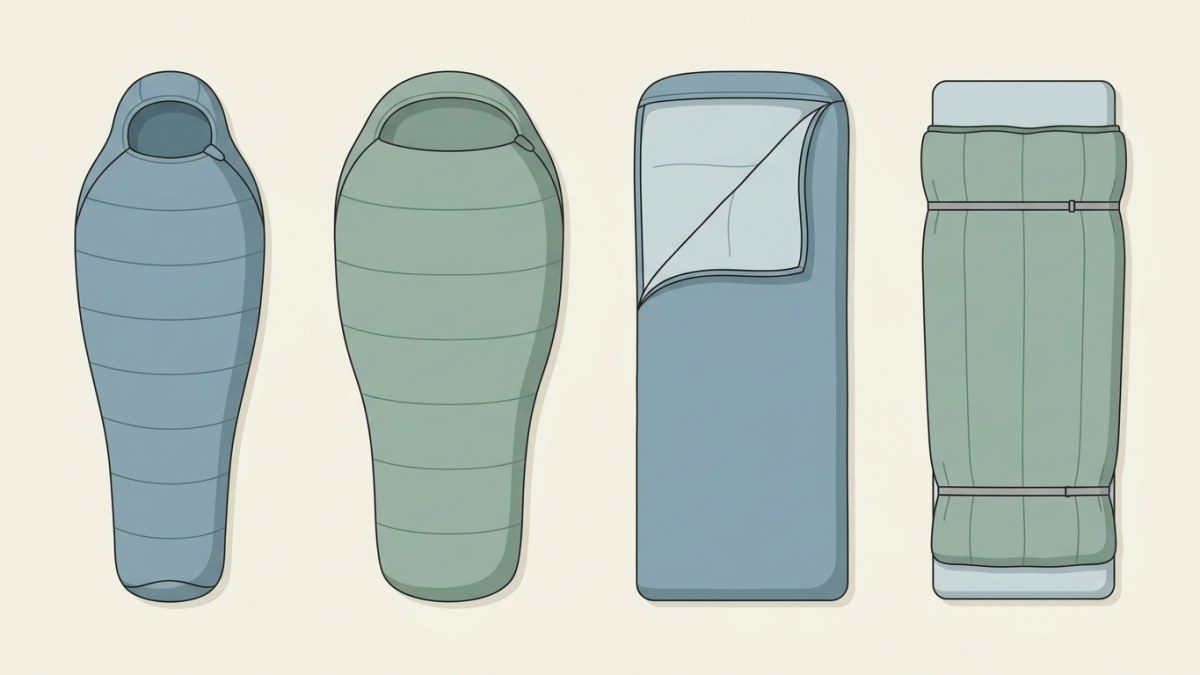
Fit matters as much as shape. A bag that is too short compresses the insulation at your head and feet,
while one that is far too long leaves cold space to heat.
Many bags come in regular and long lengths, and some are cut specifically for women,
often shorter and with extra insulation in the torso and footbox.
Down or Synthetic Fill
The insulation inside the bag is the other big choice.
Both types can keep you warm; they differ in weight, packability and how they handle moisture.
| Factor | Down | Synthetic |
|---|---|---|
| Warmth for its weight | Excellent | Good |
| Packed size | Very compressible | Bulkier |
| When damp | Loses much of its loft unless treated | Keeps more warmth and dries faster |
| Lifespan with good care | Very long | Loft fades sooner with repeated compression |
| Cost | Usually higher | Usually lower |
Down quality is described by fill power, a measure of how much space an ounce of down fills.
Higher numbers, commonly from about 550 to 800 or more, mean more loft for the same weight,
so the bag can be lighter and pack smaller.
Some down is treated to resist moisture, which helps in damp climates.
Synthetic fill makes sense for humid regions, paddling trips, tighter budgets and kids' bags that may face spills.
Down shines when weight and packed size matter most and you can keep the bag dry.
Features Worth Checking
- Hood: a shaped, adjustable hood seals in a lot of warmth on cold nights.
- Draft collar: an insulated tube around the neck stops warm air from escaping when you move.
- Draft tube: a strip of insulation along the zipper blocks cold spots.
- Zipper: a snag-resistant design with a two-way slider lets you vent your feet on warm nights.
- Footbox: a roomy, well-insulated footbox keeps your toes from pressing the insulation flat.
- Shell fabric: a water-resistant outer fabric helps shed tent condensation.
Matching a Bag to Your Trips
Before you shop, look up typical overnight lows for the places and seasons you camp most, not the daytime highs.
Temperatures generally drop as you gain elevation, and clear, calm nights get colder than cloudy ones.
- Warm-weather car camping: a roomy rectangular or semi-rectangular synthetic bag keeps things simple, comfortable and affordable.
- Three-season backpacking: a mummy or semi-rectangular bag with a comfort rating near the coldest expected low balances warmth, weight and packed size.
- Cold-weather trips: a well-hooded mummy with a draft collar, paired with a highly insulated pad, is the safest choice.
If one bag has to cover everything, choose it for the colder end of your range.
It is much easier to vent a warm bag on a mild night than to stay warm in a bag that is too light.
Frequently Asked Questions
Can I zip two sleeping bags together?
Sometimes. Many bags are sold in left-zip and right-zip versions,
and two bags with compatible zippers from the same model line can often be joined. Check before you count on it,
because zipper sizes and lengths vary.
Is a sleeping bag liner worth it?
For many campers, yes.
A liner keeps body oils and dirt off the bag, so you wash it less often, and it adds a little warmth.
On hot nights, a liner alone can be enough.
What should I wear inside my sleeping bag?
Clean, dry base layers, a warm hat and dry socks work well.
Avoid sleeping in clothes that are damp from the day,
and skip bulky layers that press against the bag and compress its insulation from the inside.
Final Thoughts
Start with the lowest temperature you expect, then choose a rating with some margin,
a shape that suits how you sleep and a fill that matches your climate and budget.
Pair it with a well-insulated pad, keep it dry and store it loosely between trips,
and a good sleeping bag will keep you warm for many years.
Sources and Further Reading
This article was reviewed by the BraverPlay editorial team against the official sources below. Rules, conditions and gear vary from place to place, so always check the latest guidance from local authorities before you head out.
- ISO 23537-1:2022 Requirements for sleeping bags - Part 1: Thermal, mass and dimensional requirements, International Organization for Standardization (ISO): An international standard sets how adult sleeping bags are lab-tested and labeled for thermal performance against cold.
- What to Bring (Camping), U.S. National Park Service: Match the bag to the temperatures and season where you camp, and use a sleeping pad so moisture beneath you does not rob body heat.
- Preventing Hypothermia, U.S. Centers for Disease Control and Prevention (CDC): Hypothermia is a medical emergency that can develop even at cool temperatures above 40°F when a person is chilled or damp.
- Atmospheric Controllers of Local Nighttime Temperature, National Weather Service (NOAA): The coldest nights come with clear skies and light winds, while cloud cover keeps nighttime temperatures higher.