
Anúncios
A surprising number of unplanned swims happen at the very edge of the water, while someone is getting in or out of a kayak.
The boat is at its tippiest when you're halfway in, with your weight high and off to one side.
Get this part right and your day starts and ends dry.
Anúncios
Below are simple, stable techniques for launching from a beach, a dock and a rocky shore,
along with how to land gracefully and the mistakes that most often end in a splash.
Three Rules for Staying Upright
Every method below follows the same principles:
- Keep your weight low. The lower your center of gravity, the more stable the boat. Sit down as soon as you can, and never stand up in a kayak.
- Keep your weight centered. Move along the boat's centerline, not onto one edge. Stepping on the side of a kayak is the quickest way to flip it.
- Keep three points of contact. Move one hand or foot at a time while the others support you, and go slowly.
Before you start, buckle your life jacket, stow your gear and put your paddle where you can reach it.
Trying to juggle loose items while climbing in is how phones and sunglasses end up on the bottom.
Getting In From a Beach or Gentle Shore
A sandy or muddy beach with a gradual slope is the easiest place to launch.
Instead of sitting in the kayak on dry land and scooting into the water, which scrapes the hull, float the boat first.
- Place the kayak in water just deep enough to float it with you inside, usually around shin-deep, and point it away from shore.
- Stand over the cockpit facing the bow, with one foot on each side of the boat.
- Rest your paddle across the deck in front of you where you can reach it, and put a hand on each side of the cockpit rim.
- Lower your bottom straight down into the seat, keeping your weight centered.
- Lift one leg in, then the other, and settle your feet onto the foot braces.
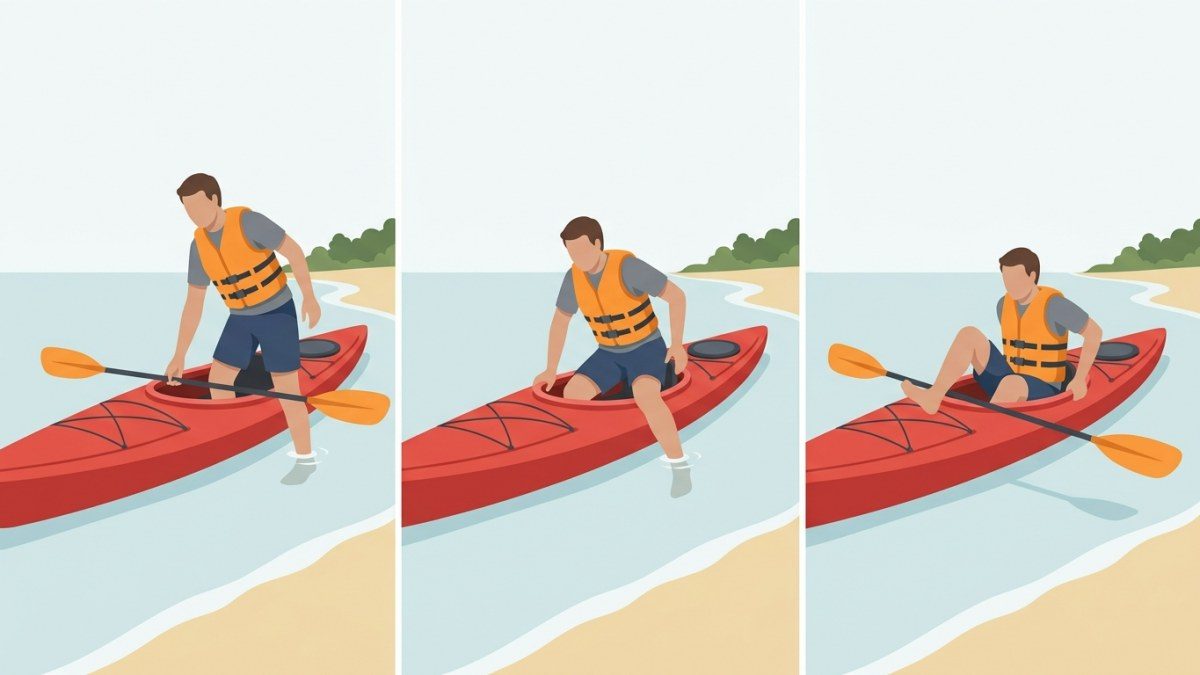
On a sit-on-top, it's even easier.
Float the kayak beside you, sit sideways on the seat with your feet still in the water,
then swing your legs aboard one at a time and push off gently with your hands or paddle.
Getting In From a Dock
Docks are trickier because the boat sits below you.
The lower the dock, the easier this is, so look for a low floating dock or a dedicated paddle launch if one is available.
- Pull the kayak alongside the dock, parallel to it and touching it. If a friend can hold it steady, even better.
- Sit on the edge of the dock beside the cockpit, then place both feet in the kayak near the center, close to the seat.
- Lay your paddle across the kayak just behind the cockpit, with one blade resting on the dock. Grip the shaft and the back of the cockpit rim together with one hand, so the paddle acts like an outrigger.
- Turn your body toward the bow and, with your other hand on the dock, lower yourself into the seat in one smooth, controlled motion.
- Bring the paddle across, settle your feet and push gently away from the dock.
If the dock sits high above the water, don't try to drop into the boat.
Find a lower launch point instead; some parks and marinas have accessible launches with rails or rollers designed for exactly this situation.
Launching From Rocky or Uneven Shores
Rocky shores take a little more care, both for you and your hull.
Wear sturdy water shoes, since rocks near the waterline are often slippery with algae.
Float the kayak in water deep enough that it isn't resting on anything sharp,
and keep one hand on it at all times so it can't drift off.
If there's a flat rock at about the height of the kayak's deck,
sit on it and slide in using the same technique as a low dock.
Otherwise, use your paddle as an outrigger,
with one blade braced on the rocks and your hand gripping the shaft and cockpit rim together,
and lower yourself in slowly.
Where small waves wash in, time your entry for a lull between them.
If waves are actually breaking at the shoreline, look for a calmer launch spot, because surf launches are a separate skill that takes instruction.
Fitting a Spray Skirt Without Wobbling
If you paddle a sit-inside kayak with a spray skirt, put it on while you're sitting stably, not while you're still climbing in.
Many paddlers do this in calm, shallow water or with a partner holding the boat.
Hook the back edge of the skirt over the rear of the cockpit rim first,
then work it around the sides and finish at the front.
Always make sure the grab loop at the front sits outside the skirt and is easy to reach,
because it's how you release the skirt quickly in a capsize.
Practice pulling it with an instructor before you rely on it.
Getting Out Without a Swim
Getting out is simply the reverse of getting in,
but people tend to rush it at the end of the day, when they're tired and stiff.
Take a moment to stretch your legs and wiggle your toes before you move.
At a beach, paddle in until the hull just touches bottom, or stop in shin-deep water.
Swing one leg out and plant your foot on the bottom, then the other, so you're straddling the cockpit.
Then stand straight up with your weight centered and step clear of the boat.
At a dock, pull alongside,
set your paddle on the dock and hold on with one hand while the other rests on the cockpit rim behind you.
Draw your feet in close, then push up and pivot to sit on the dock before you stand.
Keep a hand on the boat or a line so it doesn't drift away once you're out.
Tandem Kayaks and Special Situations
In a tandem, one person steadies the boat while the other climbs in.
At a beach, the front paddler usually gets in first while the back paddler holds the kayak steady from behind,
then the back paddler climbs in and pushes off. Reverse the order when you land.
If you have a stiff knee, sore hips or limited mobility,
a sit-on-top with a raised seat is often easier than a sit-inside,
and an accessible launch can make a big difference.
Don't hesitate to ask a friend to hold the boat; there's no prize for doing it the hard way.
Mistakes That Usually End in a Splash
- Stepping onto the kayak with one foot while the other stays on the dock
- Standing up in the boat to adjust a seat or grab something
- Putting all your weight on the paddle shaft, which can snap it
- Letting go of the dock before you're settled in the seat
- Leaning over the side to grab a bag from the dock after you've launched
- Launching into breaking waves or current without training
- Rushing because other people are waiting
Practice Makes It Smooth
Getting in and out gracefully is a skill like any other, and a few practice runs in calm, warm water make a big difference.
Try each method with a friend nearby and your life jacket on, and don't worry about getting wet while you learn.
It's far better to find your balance point on a quiet afternoon than in front of a crowded launch.
Sources and Further Reading
This article was reviewed by the BraverPlay editorial team against the official sources below. Rules, conditions and gear vary from place to place, so always check the latest guidance from local authorities before you head out.
- Paddlecraft (Including Stand Up Paddleboarding), Oregon State Marine Board: Keep a low center of gravity, three points of contact and your weight over the center; standing up in a small boat is a leading cause of falls overboard.
- Life Jacket Wear / Wearing Your Life Jacket, U.S. Coast Guard Boating Safety: Buckle on an approved life jacket before you board, since you may end up in the water unexpectedly.
- Smart Start for Safe Paddling, American Canoe Association: Loading and boarding a boat is one of the basic skills taught in the ACA's paddling safety course.