
Anúncios
Paddling a kayak is easy to start and surprisingly deep to master.
Most beginners get by with a basic forward stroke and some improvised steering, but a handful of well-learned strokes transforms how the boat responds.
You go straighter, turn exactly when you want and stay upright when a wave catches you off guard.
Anúncios
These are the strokes every kayaker should know, how to do each one and the common mistakes that hold people back.
Practice them on calm water, one at a time, and they'll soon become automatic.
Fundamentals That Make Every Stroke Better
Good strokes start with good posture.
Sit upright with a slight forward lean, feet on the foot braces and knees lightly bent.
Your legs and hips connect you to the boat, so you steer and balance with your whole body instead of just your arms.
Hold the paddle with your hands a bit wider than your shoulders and your knuckles lined up with the top edge of the blade.
Keep your grip loose, since a death grip tires your forearms fast.
If your blades are offset at an angle, called feathered, one hand stays fixed as your control hand while the shaft rotates in the other.
Finally, keep your hands in front of your body, inside what instructors call the paddler's box,
the space framed by your arms, chest and the paddle shaft.
Rotate your torso to move the paddle instead of reaching with your arms.
This protects your shoulders and adds power to every stroke.
The Forward Stroke
You'll use the forward stroke far more than any other, so it's worth refining. Break it into three phases:
- Catch: Wind up your torso and plant the blade fully in the water near your feet, close to the side of the kayak.
- Power: Unwind your torso to pull the boat past the planted blade, pushing gently with the foot on the stroke side. Your top hand stays around eye level or lower and moves across in front of you.
- Exit: Slice the blade out when it reaches your hip. Pulling it farther back just lifts water and slows you down.
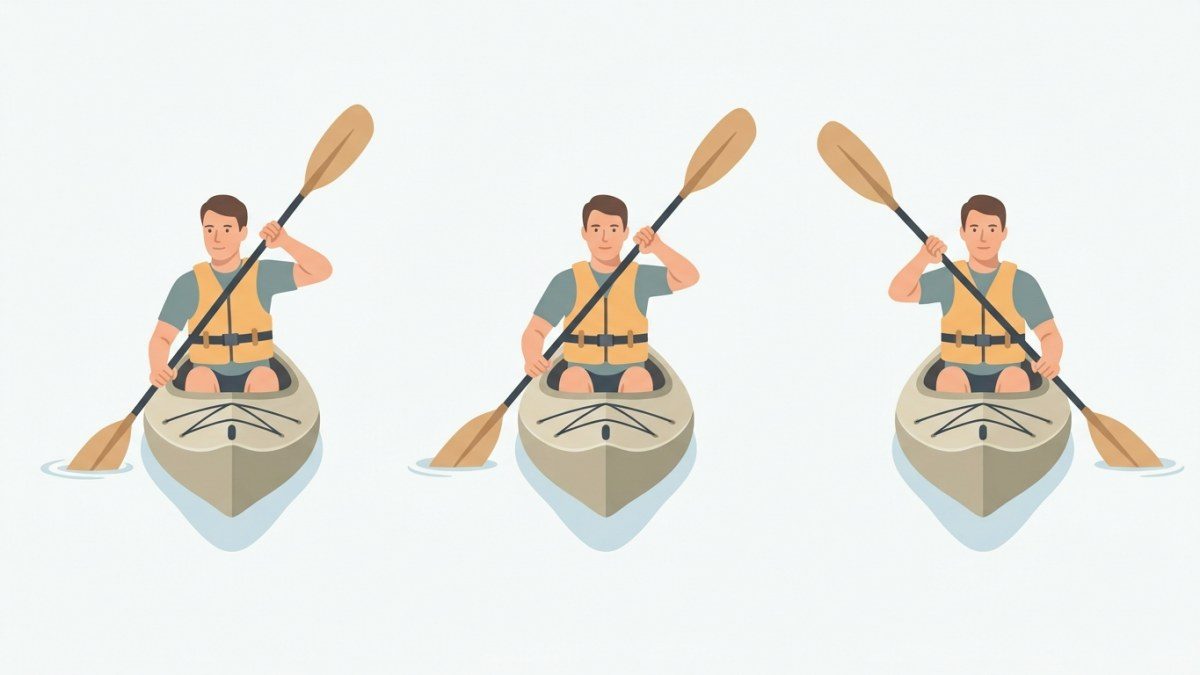
Common mistakes include paddling with bent arms and no rotation, sweeping the blade wide away from the boat,
which turns you instead of moving you forward, and not burying the blade completely.
A higher paddle angle gives more power and speed, while a lower, relaxed angle is more comfortable for long days.
The Reverse Stroke and Stopping
The reverse stroke is the forward stroke run backward. Rotate your torso toward the stroke side,
place the back face of the blade in the water just behind your hip and push it forward toward your feet.
Glance over your shoulder every few strokes so you know what's behind you.
To stop, use short, quick reverse strokes on alternating sides.
Two or three are usually enough to take the glide out of a recreational kayak,
while a long touring boat carries more momentum and needs more.
When backing up over any distance, expect the kayak to wander, and use a gentle sweep on one side to bring it back on course.
Sweep Strokes for Turning
A forward sweep turns the kayak away from the paddle side.
Plant the blade near your feet, then draw a wide,
flat arc out to the side and back toward the stern, keeping the shaft low and your arms fairly straight.
Follow the blade with your eyes to encourage full torso rotation.
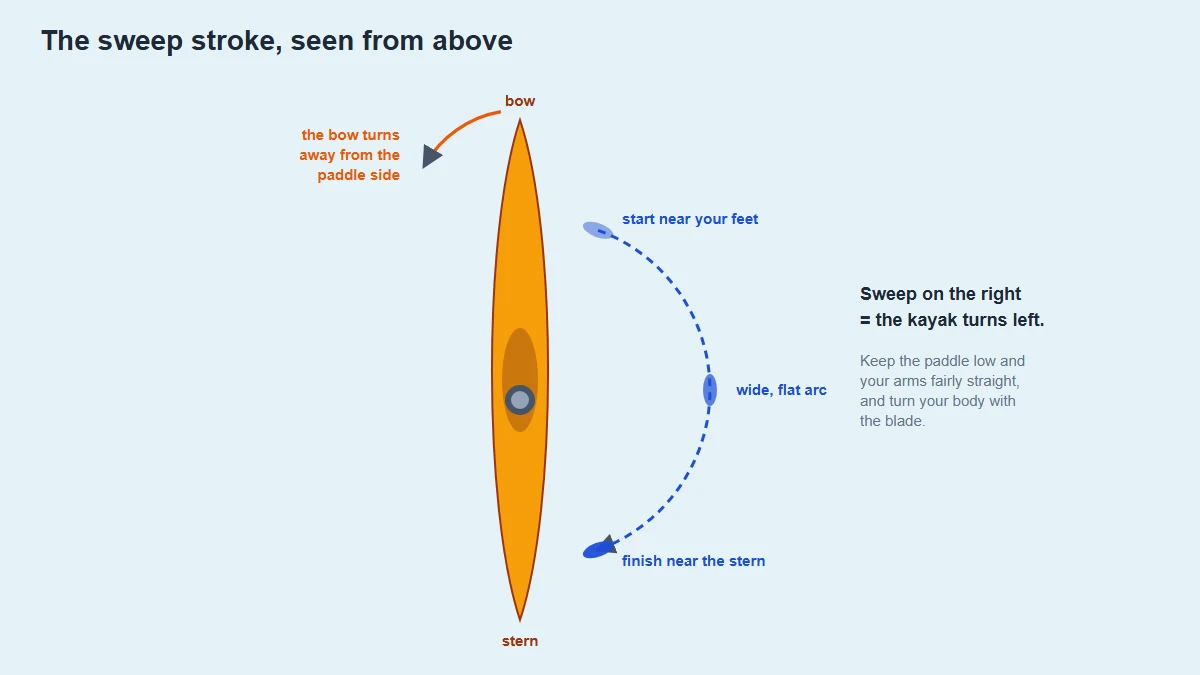
A reverse sweep does the opposite: start near the stern and sweep forward toward the bow, turning the kayak toward the paddle side.
Combine a forward sweep on one side with a reverse sweep on the other and the kayak spins almost in place,
which is handy in tight spots.
As your balance improves, try tilting the kayak slightly toward the side you're sweeping on.
This edging lets the hull pivot more freely, and it's a foundation for more advanced boat control.
The Draw Stroke for Moving Sideways
A draw stroke moves your kayak sideways, which is perfect for pulling up alongside a dock or another boat.
Rotate your torso to face the side,
reach out and place the blade in the water about an arm's length from the hull,
with the blade face parallel to the kayak, then pull the boat toward it.
Stop before the blade reaches the hull, or it can catch and tip you.
Either slice it out toward the stern,
or rotate it a quarter turn and slice it back out underwater to the starting point for the next draw.
Keep the shaft as vertical as you can, with your top hand high and out over the water.
Once you're comfortable, learn the sculling draw, where the blade moves back and forth in a short, shallow arc beside the boat.
It produces a continuous sideways pull without lifting the blade out.
The Stern Rudder for Steering
The stern rudder isn't a propulsion stroke; it's a steering tool.
At the end of a forward stroke, leave the blade trailing in the water near the stern, fairly vertical and parallel to the kayak.
Pushing the blade away from the hull turns the bow toward the paddle side, and pulling it in turns the bow away.
It's most useful when you're gliding and want to hold a line without losing speed, or when following waves and wakes push the stern around.
It also works well from the back seat of a tandem kayak.
The Low Brace for Staying Upright
A brace is your recovery move when the kayak starts to tip. For a low brace,
hold the paddle low in front of you with your knuckles pointing down and your elbows above the shaft,
like the top of a push-up.
As you feel yourself going over, slap the back face of the blade flat onto the water on the side you're tipping toward.
The blade gives you a brief moment of support, but the real recovery comes from your hips.
Use your knee to lift the low edge of the boat back under you, and bring your head up last,
keeping it low over the kayak. Lifting your head first pulls the boat over.
The high brace uses the power face of the blade with your knuckles up,
but it can put your shoulder at risk if your arms rise overhead.
Keep your elbows low and in front of your body, and learn it with an instructor.
How to Practice
- Choose warm, calm, shallow water close to shore, ideally with a friend nearby.
- Work on one stroke at a time for several minutes, then switch sides.
- Ask someone to take a short video of you from shore; it reveals habits you can't feel.
- Practice braces where a capsize is harmless, and learn to exit your kayak safely first.
- Take a lesson. An instructor can fix in minutes what might take you a whole season to figure out.
Simple drills keep practice focused. Paddle toward a fixed point on shore and count how many strokes you can take before you need a correction.
Spin the kayak in a full circle using only sweep strokes, first one way and then the other.
Then pick a dock post or buoy and use draw strokes to slide up beside it without bumping it.
Putting It All Together
Out on the water, strokes blend together. You'll finish a forward stroke with a touch of stern rudder,
slip into a draw to reach a dock or throw in a quick low brace when a wake rolls under you.
The more you practice each one on its own, the more naturally they'll combine, and the more control and confidence you'll have wherever you paddle.
Sources and Further Reading
This article was reviewed by the BraverPlay editorial team against the official sources below. Rules, conditions and gear vary from place to place, so always check the latest guidance from local authorities before you head out.
- Smart Start for Safe Paddling, American Canoe Association: Paddling strokes, boat handling and rescue skills are core beginner skills, best learned in a course with a certified instructor.
- Paddlecraft (Including Stand Up Paddleboarding), Oregon State Marine Board: Start on calm, flat water, practice self-rescue and reboarding skills, and keep a low center of gravity in the boat.
- Common Paddling Hazards, National Center for Cold Water Safety: Being unable to recover from a capsize is a major accident factor, so rescues must be practiced until they're automatic.