
Anúncios
Getting lost can happen to anyone, from first-time hikers to people with decades of experience.
A faint side trail, a snow-covered path or a moment of distraction is all it takes.
What happens next depends far less on how you got lost than on what you do in the first few minutes.
Anúncios
The steps below give you a calm, practical plan: how to keep the situation from getting worse,
work out where you are, decide whether to move or stay put, and help rescuers find you quickly.
First, STOP
The moment you realize you are not sure where you are, stop walking.
The natural reaction is to hurry on in search of something familiar, and that is how a small detour turns into being seriously lost.
Many outdoor safety programs teach a simple acronym:
- Stop: Stand still, take a drink of water, eat something and let the rush of adrenaline pass.
- Think: When did you last know exactly where you were? How long ago was that, and which direction have you been heading since?
- Observe: Look around for landmarks, trail markers, footprints and the position of the sun, and listen for roads or running water. Check your map, compass and phone.
- Plan: Decide on your next step based on what you know, not on hope.
Feeling scared is normal.
Taking a few slow, deep breaths helps you think clearly, and clear thinking is your most important tool right now.
Work Out Where You Are
Start with your navigation tools.
A phone with downloaded maps can often show your position even without cell service, because its GPS receiver works independently of the cell network.
Compare that position with your paper map, and look for features you can recognize, such as a peak, a lake or a distinctive ridge.
If you can identify your last known point and you are confident of the way back, retrace your steps carefully.
Mark your path as you go,
for example by scratching an arrow in the dirt or laying a stick across it,
so you can return if the route does not work out.
Do not wander in search of the trail, and move only with a clear purpose.
If nothing looks familiar, a short walk to a nearby high point or open area with a view can help you spot landmarks.
Go only if the way is safe and you can reliably return to where you started, and keep your pack with you.
A common piece of advice is to follow a stream downhill to reach civilization.
Be cautious with it, because streams can lead into steep gorges, waterfalls and dense brush that are hard to escape.
Decide Whether to Stay or Move
If you cannot find your way back with confidence, staying put is usually the best choice,
especially if someone knows your plans and when you are due back.
A person who stays in one place is far easier to find than one who keeps moving, and searchers typically start with your planned route.
Stay where you are if:
- You are injured, exhausted or unsure of the way.
- It is getting dark or the weather is closing in.
- You have already tried to find the trail without success.
- Someone expects you back and will raise the alarm.
Moving can make sense if you know exactly how to get back to a known trail or road,
or if your current spot is dangerous, such as a flood-prone creek bed,
an exposed ridge during a lightning storm or an avalanche path.
Moving a short distance to a nearby clearing where you are easier to spot can also help.
Call for Help Early
If you have a signal, call for help sooner rather than later.
It is far easier for rescuers to reach someone who is lost but safe in daylight than someone who is injured in the dark.
Use your local emergency number: 911 in the US and Canada, 999 or 112 in the UK,
and 000 in Australia, where 112 also works from mobile phones.
Describe your situation clearly, including the trail you started on,
when you last knew where you were and what you can see around you, and share your location,
ideally as GPS coordinates from your phone's map or compass app.
Then follow the dispatcher's instructions, which usually include staying where you are.
If a call will not connect, try sending a text message to a friend or family member,
since texts can sometimes get through on a weak signal when calls cannot.
A satellite messenger or personal locator beacon can send an emergency alert where phones have no coverage.
Once help is on the way, save battery by turning on low-power mode, dimming the screen and closing apps,
and keep the phone warm in an inside pocket.
Make Yourself Easy to Find
Searchers look and listen for signs of you, so give them as many as you can:
- Use your whistle: Three blasts is a widely recognized distress signal (in the UK, the standard signal is six blasts repeated every minute), and a whistle carries farther and lasts longer than shouting.
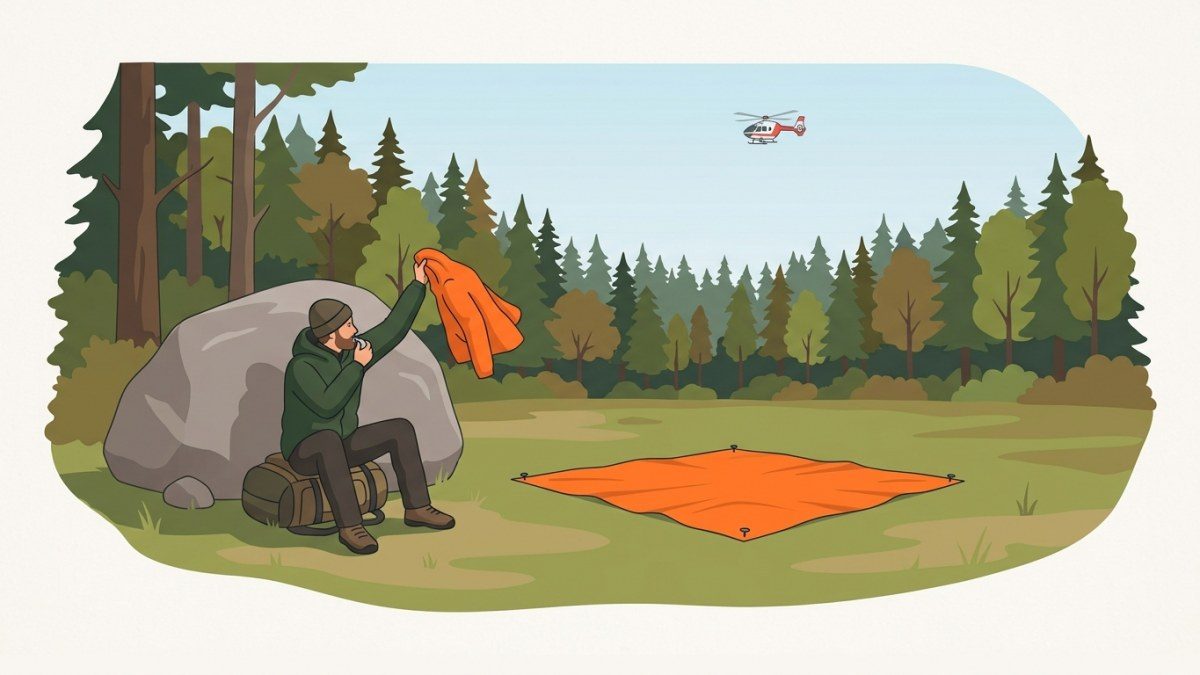
- Be visible: Spread brightly colored clothing or gear in an open area, and stay near the edge of a clearing rather than deep in dense trees.
- Use light: At night, flash your headlamp in sets of three (six flashes a minute in the UK). By day, a mirror or any shiny object can flash sunlight toward aircraft or distant hikers.
- Answer searchers: Respond to shouts, whistles or the sound of aircraft, and never hide from searchers out of embarrassment.
If you hear a helicopter or plane, move into the open if you can do so safely and wave something bright.
From the air, movement and strong color contrast are far easier to spot than a person standing still under trees.
Stay Safe While You Wait
Your job now is to stay warm, dry and calm. Find or make shelter out of the wind,
such as the lee side of a boulder or a stand of dense trees,
while staying close enough to open ground to be spotted. Put on your extra layers before you get cold,
and sit on your pack, a sit pad or a pile of dry branches to insulate yourself from the ground,
which draws heat from your body.
If darkness falls before help arrives, stay where you are.
Trying to find your way at night, even with a headlamp,
greatly raises the risk of a fall and of wandering farther from where searchers expect you.
Keep drinking water and eating small amounts, and stay as dry as possible.
If you carry an emergency blanket or bivy sack, use it.
A small fire can provide warmth and comfort in a genuine emergency,
but only if you can build it safely away from dry vegetation and keep it under control.
Stay positive and busy.
Improving your shelter, organizing your gear and signaling at regular intervals keep your mind focused and the hours moving.
How to Avoid Getting Lost Next Time
Most lost-hiker situations can be prevented with a few habits:
- Study the route and carry a map, even on familiar trails.
- Check your map at every junction, and look back often so you recognize the trail on the return.
- Leave a trip plan with someone who will call for help if you are overdue.
- Set a turnaround time and stick to it.
- Stay on established trails and avoid unofficial paths or shortcuts.
- Practice your navigation skills and consider taking a course.
Staying Found
If you get lost, stop, think, observe and plan.
Retrace your steps only if you are confident; otherwise stay put, call for help, make yourself visible and keep warm while you wait.
With calm thinking and a few simple tools, a frightening moment is far more likely to end with a safe walk out.
Sources and Further Reading
This article was reviewed by the BraverPlay editorial team against the official sources below. Rules, conditions and gear vary from place to place, so always check the latest guidance from local authorities before you head out.
- Outdoor Emergency Plan, U.S. National Park Service: What to do when lost: retrace steps only if safe, call 911 with GPS coordinates, stay put, find shelter, keep warm and signal with whistle, light and mirror.
- Trip Plan, AdventureSmart (Canada): The STOP method (Stop, Think, Observe, Plan), staying put to shrink the search area, keeping warm and dry, and signaling in threes.
- How it works, Mountain Rescue England and Wales: How to call mountain rescue in the UK: dial 999, ask for the police, then mountain rescue.
- Know how and when to get help, AdventureSmartUK: UK emergency calls, conserving phone battery, and the UK distress signal of six whistle blasts or torch flashes repeated every minute.
- Backcountry safety - Jasper National Park, Parks Canada: Retracing your steps when unsure of the route, keeping the group together and being ready to survive at least one night out, since searches take time.