
Anúncios
Sooner or later, every paddler ends up in the water.
It might be a slow-motion tip while reaching for a hat, a wake you didn't see coming or a planned practice session in the shallows.
What happens next depends far less on luck than on what you do in the first few seconds and how much you've practiced.
Anúncios
Here's how to handle a capsize calmly, get back into a kayak, canoe or paddleboard,
and recognize when it's time to stop trying and call for help.
The First Few Minutes: Breathe, Then Act
If the water is cold, your body may react with cold-water shock: an involuntary gasp followed by rapid, uncontrolled breathing.
It usually lasts for the first two to three minutes or longer, and during that time it's easy to inhale water.
Your life jacket keeps your head up, so focus entirely on slowing your breathing,
keeping your face out of the water and holding on to your boat.
Don't try to swim hard until your breathing is under control.
Even in warm water, a sudden capsize is disorienting.
Take a moment to get your bearings, find your paddle and look for the rest of your group.
If you're paddling with others, a quick shout or wave lets them know you're okay.
Stay With Your Boat, With Some Exceptions
On lakes and the sea, your boat is your best friend after a capsize.
It floats, it's much easier to see than a head in the water and it's your ride home.
Hold on to it and your paddle; tuck the paddle under an arm or clip it to the boat so your hands stay free.
There are important exceptions:
- In moving water, stay upstream of your boat, never between it and a rock or tree. A swamped boat carries enormous force in current.
- If the boat is carrying you toward a hazard, such as a strainer, dam or rocks, let it go and swim for safety.
- If the boat blows away faster than you can swim, don't wear yourself out chasing it.
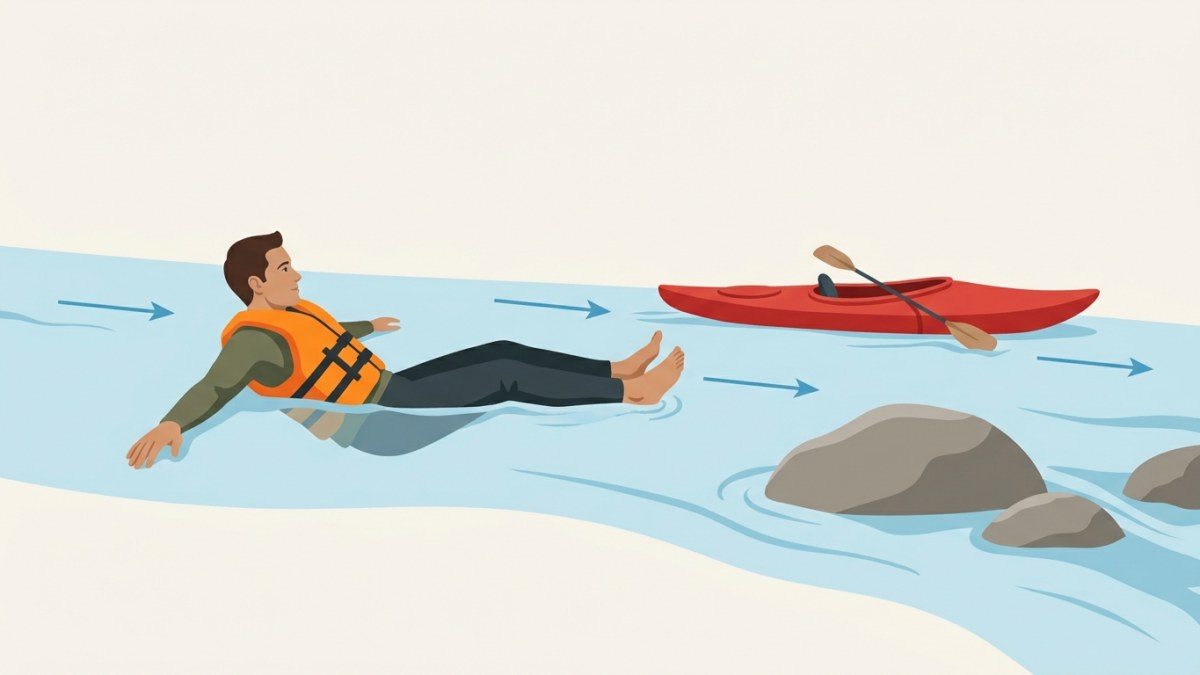
When you're swimming in current, lie on your back with your feet pointed downstream and near the surface,
so your feet rather than your head meet any rocks.
Swim toward shore or an eddy when you can, and don't stand up until the water is shallow and slow.
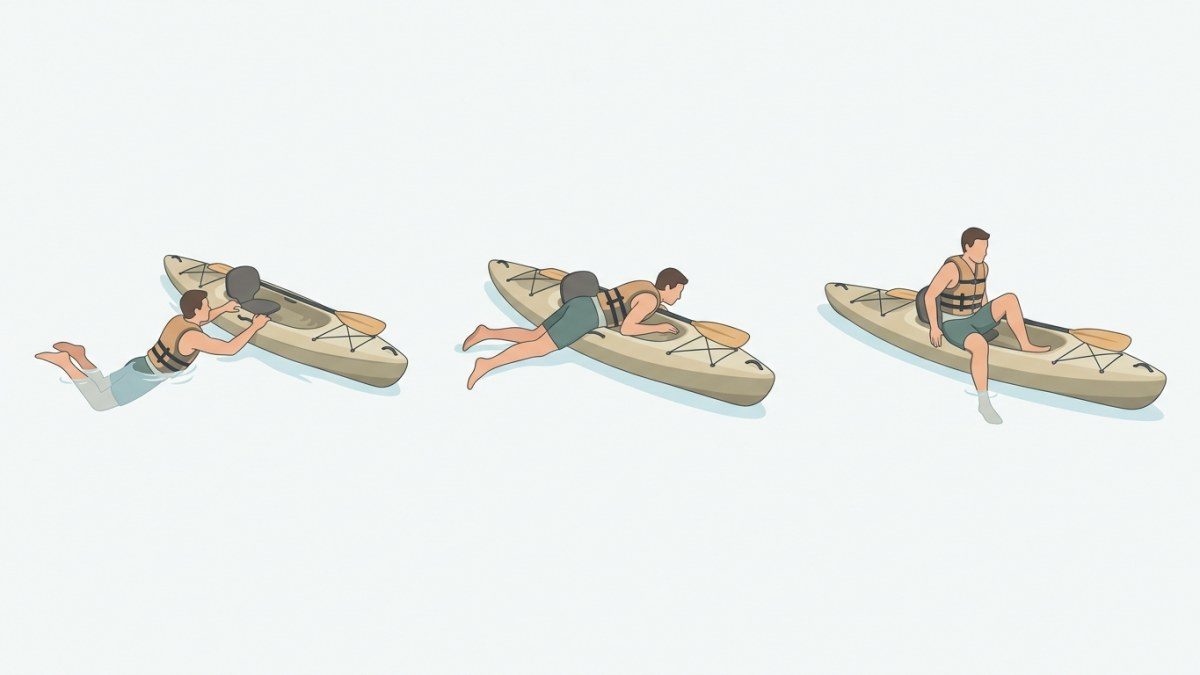
Getting Back Onto a Sit-On-Top Kayak
- Flip the kayak upright by reaching across the hull, grabbing the far edge and pulling it toward you.
- Move to the side of the kayak next to the seat, with your paddle secured.
- Reach across and grab the far side or a handle, then let your legs float up to the surface behind you.
- With a strong kick, pull your chest and belly across the deck so you're lying across the boat.
- Rotate your hips toward the seat, sit down while keeping low and swing your legs in one at a time.
Sit-Inside Kayaks: Wet Exit and Re-Entry
If you tip over in a sit-inside kayak with a spray skirt, stay tucked forward,
find the grab loop at the front of the skirt and pull it forward and up to release it.
Then put your hands by your hips, push the kayak away from you and roll forward out of the cockpit,
coming up next to your boat.
This is called a wet exit, and you should practice it with an instructor before you ever need it.
Getting back in is harder, because the cockpit is full of water. Common methods include:
- Assisted rescue: Another paddler lifts one end of your kayak across their deck to drain it, flips it upright and holds it steady while you climb back in.
- Paddle float self-rescue: An inflatable float on one blade turns your paddle into an outrigger, steadying the kayak while you climb onto the back deck and slide into the seat.
- Swim to shore: If land is close and you're staying warm, towing your boat to shore is often the simplest option.
A kayak without bulkheads or float bags can fill almost entirely with water and may be impossible to empty in deep water.
That's one more reason to stay close to shore in a recreational kayak.
Canoes and Paddleboards
A swamped canoe with adequate flotation stays at the surface, but it's heavy and unstable.
If you're near shore, the simplest option is often to hold on to one end and kick it in.
Another canoe can help with an assisted rescue, lifting and emptying your canoe across theirs, which is a technique worth learning in a course.
Climbing back into a canoe from deep water is awkward. It works best from the middle of the boat,
with a partner leaning out on the opposite side as a counterweight while you kick hard and pull yourself across.
Paddleboards are the easiest to recover, and your leash keeps the board close.
Put the paddle on the deck, grab the center handle from the side,
kick your legs to the surface and slide onto the board on your stomach,
then come up to your knees before standing.
When to Call for Help
Know when to stop trying on your own.
Call or signal for help if you've tried to get back in and can't,
if you or anyone else is becoming very cold, weak or clumsy, if someone is injured or has inhaled water,
or if wind, waves or current are carrying you toward danger or away from shore.
Blow three blasts on your whistle, a widely recognized distress signal, and wave an arm or your paddle overhead.
Use your phone or marine radio if it's protected and within reach.
Stay with your boat if it's safe to do so, since it makes you far easier to spot.
After You're Back on Shore
Even a short swim can chill you more than you realize.
Get out of the wind, change into dry clothes and warm up with extra layers,
plus something warm to drink if you're alert and able to swallow normally.
Keep an eye on everyone who went in, since early signs of hypothermia include shivering, fumbling hands, slurred speech and confusion.
Get medical help right away if someone becomes confused, very drowsy or stops shivering while still cold.
Anyone who inhaled water or hit their head should be checked by a medical professional, even if they seem fine at first.
Helping a Partner and Practicing Rescues
When someone else capsizes, keep yourself safe first, because a second swimmer makes everything harder.
Talk to them, check that they're okay and ask them to hold on to their boat.
Approach carefully so a panicked grab doesn't tip you too,
and offer the bow or stern of your boat for them to hold rather than letting them pull on your side.
Rescuers often follow the order reach, throw, row and only then go, trying to help from a position of safety before ever entering the water.
If you haven't trained in assisted rescues, help the swimmer toward shore and call for help rather than improvising a technique you don't know.
Rescue skills fade quickly when you only read about them.
Take a rescue and self-rescue course, then practice in warm, shallow water with a partner or instructor nearby.
Practice in the clothes and gear you actually paddle in,
repeat the drills every season and try them in slightly livelier conditions as your confidence grows.
The Takeaway
A capsize is a problem to solve, not a disaster.
Breathe through the first few minutes, hold on to your boat unless it's leading you into danger,
use the re-entry skills you've practiced and call for help early rather than late.
With training and a life jacket always on, tipping over becomes just another part of paddling.
Sources and Further Reading
This article was reviewed by the BraverPlay editorial team against the official sources below. Rules, conditions and gear vary from place to place, so always check the latest guidance from local authorities before you head out.
- Cold Water Hazards and Safety, National Weather Service (NOAA): Cold shock gasping and rapid breathing last for the first 2-3 minutes or more; wear a life jacket and dress for the water.
- Cold Shock, National Center for Cold Water Safety: Swimming while hyperventilating from cold shock is often impossible, even for good swimmers, which is why the life jacket matters.
- River Safety: Upper Delaware Scenic and Recreational River, U.S. National Park Service: In current, float on your back with feet up and downstream, stay upstream of your boat and never stand in rapids.
- Paddle Safety, NSW Government (Transport for NSW): After a capsize, stay with your craft so you're easier to see, rather than trying to swim to shore.
- Hypothermia, NHS: Signs of hypothermia and first aid: shelter, remove wet clothes, a warm non-alcoholic drink if fully awake, and medical help.