
Anúncios
Getting your kayak or canoe to the water is part of every paddling trip,
and it's where plenty of damage happens: dented hulls, scratched roofs and, worst of all,
boats that shift or come loose at highway speed. A poorly secured boat is a hazard to you and to everyone driving behind you.
Anúncios
The good news is that carrying a boat safely isn't complicated. Here's how to choose a carrying system,
load the boat without straining your back,
tie it down properly and keep it secure all the way to the launch.
Know Your Roof's Limits
Before buying anything, check your vehicle owner's manual for the roof's maximum load.
Racks have their own weight ratings too, and the lower of the two numbers is your real limit.
Remember that it includes the rack itself and every boat and accessory you put on it.
Some vehicles have low limits or no approved roof mounting points at all, so read the manual rather than guessing.
Factory roof rails and crossbars vary a lot in strength and spacing. The farther apart your crossbars are,
the better they support a long boat and the less it can pivot in a crosswind,
so spread them as wide as your roof and rack allow.
Choose a Carrying System
- Foam blocks: Pads that sit on the roof, with straps running through the open doors. They're inexpensive and work for occasional, shorter trips, but they're less secure than a proper rack.
- Crossbars with saddles or cradles: Padded supports that hold a kayak hull-down and spread the load.
- J-style cradles: Hold a kayak on its side, leaving room for a second boat or a cargo box.
- Stackers: Upright posts that let you carry several kayaks on edge.
- Load-assist systems: Rollers or lift-and-slide mounts that make loading easier on tall vehicles.
- Canoe mounts: Padded crossbars with gunwale brackets that stop an upside-down canoe from sliding sideways.
Trailers and pickup trucks with bed extenders are other options, especially for multiple boats or long canoes.
If you use a truck bed, support the boat so it doesn't rest its full weight on the tailgate edge,
and secure it just as carefully as you would on a roof.
Loading Without Straining Yourself
With two people, loading is simple: stand at each end,
lift together using your legs rather than your back and set the boat gently onto the rack.
Kayaks usually go on hull-down in saddles or on their side in J-cradles; canoes go on upside down with the gunwales resting on the bars.
Solo, the easiest method for many cars is to load from the back.
Lay a towel or mat over the rear of the roof to protect the paint,
lift the bow onto the rear crossbar, then lift the stern and slide the boat forward into position.
Keep your back straight, avoid twisting while holding weight and ask for help with heavy boats.
A canoe can be loaded solo the same way,
one end at a time: rest one end on the rear crossbar, then walk to the other end,
lift and slide it forward.
Experienced canoeists sometimes carry the canoe overhead on their shoulders and lower it onto the rack, but that takes practice and a light boat.
Tie It Down the Right Way
- Center the boat front to back and side to side on the rack.
- Use cam straps, not ratchet straps. Ratchets make it easy to overtighten and can deform or crack a hull.
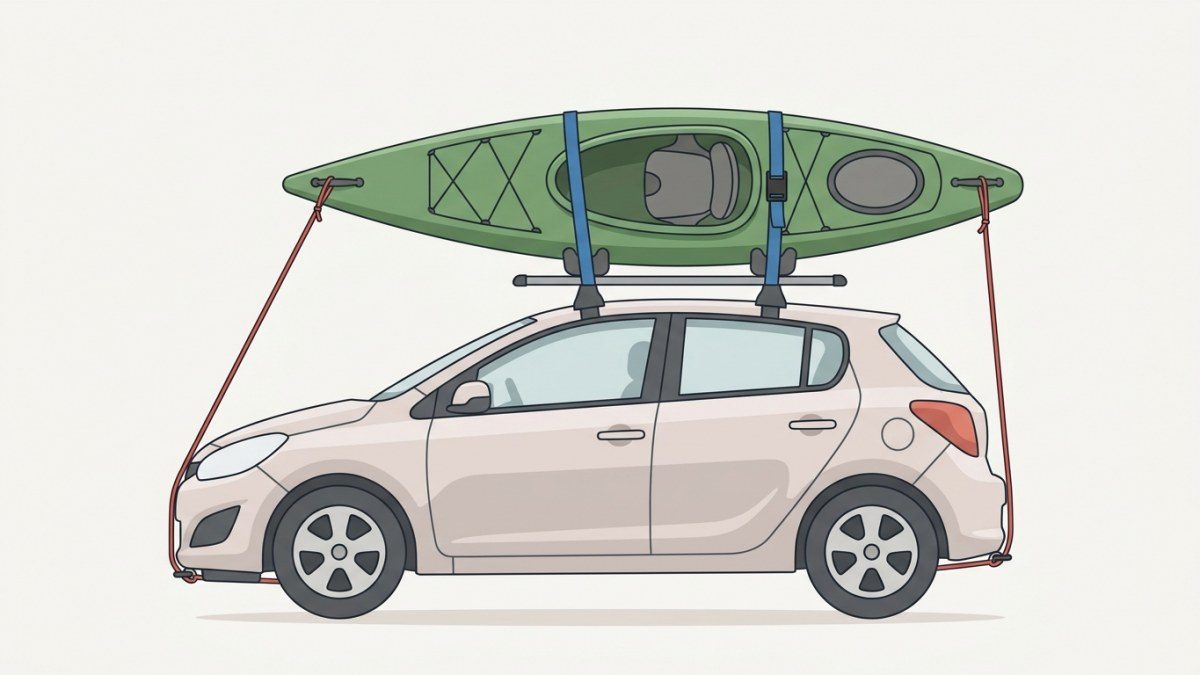
- Run one strap around each crossbar, over the boat and back, keeping the straps inside the rack towers so they can't slide off the ends of the bars.
- Tighten until snug, not crushing. Plastic hulls can dent if straps are cranked down, especially in hot sun.
- Put a twist in each strap where it runs through open air between the boat and the bar. This simple trick stops the loud humming and vibration straps can make at speed.
- Add bow and stern lines from each end of the boat to solid points at the front and back of the car, such as tow hooks or under-hood strap loops. Keep them snug but not so tight that they bend the boat. They stop it from shifting or lifting in crosswinds and hard braking, and many boat and rack makers recommend them, especially for canoes and long kayaks.
- Tie off loose strap ends so they can't flap against the car or work loose.
- Do a shake test. Grab the boat and push it side to side. The car should rock with it; the boat shouldn't move on the rack.
On the Road
Check the straps after the first few miles and at every stop.
Straps settle as the boat beds into the pads, and some stretch when they get wet.
Drive a little more gently than usual, especially in crosswinds, on highways and over bridges, and allow extra stopping distance.
Remember the extra height and length. Watch out for low garage doors, parking structures and drive-through lanes,
and check local rules on how far a load can extend past your vehicle and whether an overhanging end needs a flag or marker.
Remove paddles, seats and loose gear from the boat before driving.
For long trips, a cockpit cover keeps rain from pooling inside the kayak, where it adds weight, and reduces wind noise.
From the Car to the Water
The trip doesn't end in the parking lot.
Two people can carry a kayak or canoe easily by the grab handles at each end.
Carrying a boat full of gear is much harder on the hull and your back,
so carry the gear separately and load it at the water's edge.
Solo, many paddlers carry a kayak on one shoulder, with the cockpit rim resting on the padded shoulder of their life jacket.
A wheeled kayak cart makes long walks to the launch far easier, especially with heavy fishing kayaks.
Avoid dragging your boat across pavement or rocks, which wears through plastic hulls and scratches composite ones over time.
Unloading and Storage Tips
Unload in reverse order: untie the bow and stern lines,
release the cam straps and lift the boat down with the same care you used to put it up.
Don't leave a boat strapped tightly to the roof for days in hot weather, since sustained pressure can deform a plastic hull.
At rest stops, a lockable cable run through the boat and rack deters opportunistic theft.
At home, store boats off the ground, out of direct sunlight and supported at their strongest points,
usually near the bulkheads or about a third of the way in from each end.
Frequently Asked Questions
Can I carry a kayak without a roof rack?
Yes.
Foam block systems work on many cars for occasional trips, and pickup beds with extenders or small trailers are other options.
Inflatable kayaks and canoes avoid the problem entirely by packing into the trunk.
Should a kayak ride hull up or hull down?
It depends on your rack and boat.
Many kayaks ride well on their side in J-cradles or hull-down in padded saddles that match the hull shape.
Resting a plastic hull directly on bare bars can dent it, so follow the boat maker's guidance.
Canoes almost always ride upside down.
How many boats can my car carry?
That depends on the width of your roof, your rack and, most importantly,
the combined weight of the boats and rack compared with your roof's load limit.
Stackers and J-cradles help fit more boats, but never exceed the weight rating.
Arrive With Your Boat Intact
Safe transport comes down to a few habits: know your roof's limits, use a proper carrying system,
strap with cam straps, add bow and stern lines and check everything before and during the drive.
Build that routine now, and every trip will start with your boat exactly where you left it.
Sources and Further Reading
This article was reviewed by the BraverPlay editorial team against the official sources below. Rules, conditions and gear vary from place to place, so always check the latest guidance from local authorities before you head out.
- The Highway Code: Rules for Drivers and Motorcyclists (89 to 102), GOV.UK (Department for Transport): Drivers must secure their load so it can't shift or stick out dangerously, and must not overload the vehicle.
- Manual Handling at Work: Good Handling Technique, Health and Safety Executive (HSE): Lift with a stable stance and bent knees, keep the load close, avoid twisting your back and get help with heavy loads.
- Smart Start for Safe Paddling, American Canoe Association: Transporting a boat and securing it to your vehicle are core topics in the ACA's basic paddling safety course.