
Anúncios
A great campsite is not luck.
Experienced campers read the land in a few minutes, checking the ground, the slope, the trees overhead,
the wind and the path water will take if it rains.
Anúncios
That quick survey is the difference between a restful night and waking up in a puddle.
The same principles apply whether you are choosing among numbered sites in a campground or picking a spot in the backcountry.
Learn to evaluate a site the way seasoned campers do, then run through the short checklist at the end every time you arrive.
Know Where You Are Allowed to Camp
Start with the rules, because they narrow your options before anything else.
In developed campgrounds, you camp only in your assigned or chosen site and pitch tents on the designated pad or clearing.
In the backcountry, some areas require designated sites or permits, while others allow dispersed camping with rules about distance from water, trails and roads.
Check the land manager's current regulations before you go, along with any fire restrictions, closures or seasonal wildlife rules.
A site that looks perfect is not worth a fine or damaged habitat if camping there is not permitted. At first-come,
first-served campgrounds, arriving early in the day, especially midweek, gives you the widest choice of sites.
Start With the Ground
Look for a spot that is flat, level and big enough for your whole tent, including vestibules and guy lines,
plus a little room to walk around it.
Where you have a choice, pitch on durable surfaces such as an established tent pad, compacted bare soil,
gravel or dry grass rather than living plants, which crush easily and take a long time to recover.
Before you unpack, clear away sticks, pinecones and loose stones by hand, then lie down on the spot for a few seconds.
Roots and rocks that are invisible while standing become obvious when your hip is on top of them.
If the ground slopes slightly, plan to sleep with your head uphill.
Think Like Water
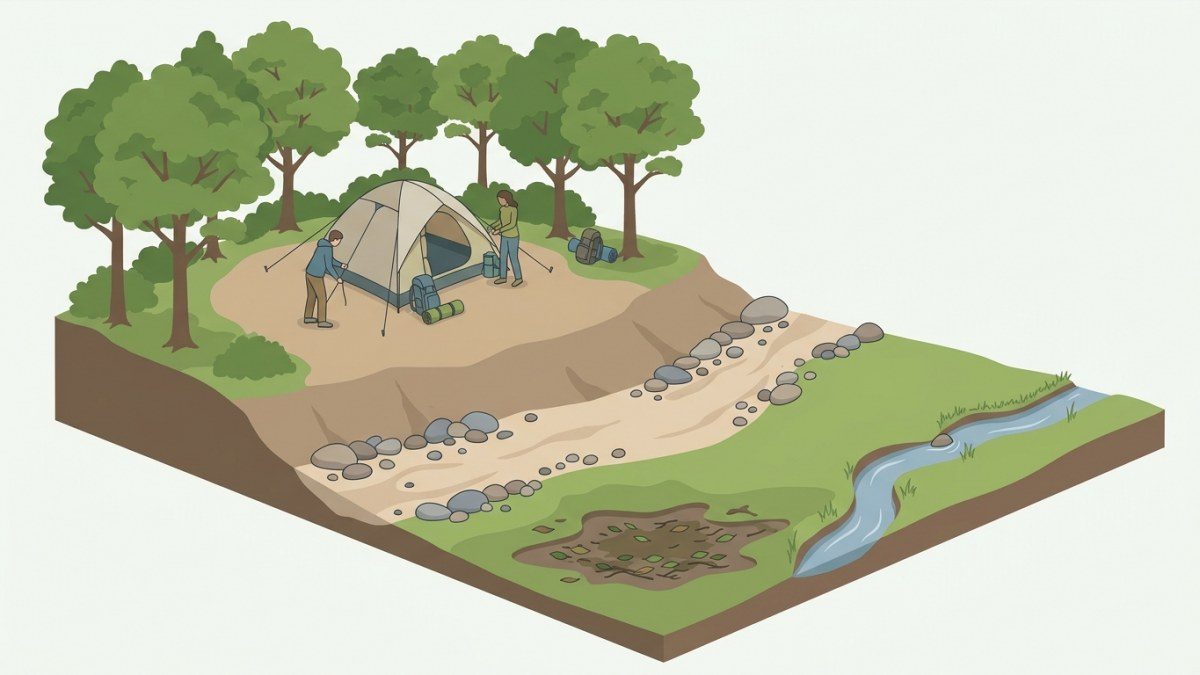
Rain does not only fall on your tent; it also flows across the ground toward the lowest point.
Avoid shallow depressions,
flat areas at the bottom of a slope and any spot where matted leaves or silt show that water has pooled or run before.
Slightly raised, gently crowned ground drains best.
Take flash floods seriously. Never camp in a dry wash, gully or narrow canyon bottom,
and keep well above the banks of rivers and streams,
which can rise quickly after rain upstream even when the sky over you is clear.
Resist the urge to dig trenches around your tent; trenching scars the site and is prohibited in many places.
Look Up and Look Around
Some of the most serious campsite hazards are above your head.
Scan nearby trees for dead or broken branches, sometimes called widowmakers, and never pitch beneath dead or leaning trees that could fall in wind.
Also avoid the base of steep cliffs or loose slopes where rocks may tumble down.
Then check the ground around the site for anything that could make the night unpleasant:
- Ant hills, wasp nests or beehives
- Poison ivy, poison oak or stinging plants
- Animal trails, droppings or signs of digging that suggest regular wildlife traffic
- Sharp rocks or broken glass left by previous visitors
Read the Wind, Sun and Temperature
Wind can be a friend or an enemy.
A light breeze keeps mosquitoes away and reduces condensation, but strong gusts stress tent poles and make cooking difficult.
In windy areas, use natural windbreaks such as boulders, dense shrubs or a stand of trees, and point the narrowest,
lowest end of the tent toward the prevailing wind.
Sun matters too. In hot weather, afternoon shade keeps your tent from turning into an oven.
In cool weather, a site with an open view to the east catches early sunshine,
which dries dew off the fly and warms you up faster.
Remember that cold air sinks.
On clear, still nights, valley floors and low meadows can be noticeably colder and damper than ground a little higher up the slope.
Camping slightly above the bottom, but not on an exposed ridge, often gives the most comfortable night.
Ridges and open summits are also the worst places to be during a thunderstorm.
Water, Wildlife and Neighbors
Being close to water is convenient, but camping right on the shore damages fragile banks,
disturbs animals that come to drink and puts you closer to mosquitoes breeding in still water.
A widely used guideline for backcountry camping is to stay about 200 feet (roughly 70 adult steps) from lakes and streams,
though local rules may set their own distance.
If you are in bear country or anywhere with curious wildlife,
make sure the site has a suitable spot to cook and store food away from your tent.
In campgrounds, think about your neighbors, too.
Sites next to restrooms or water spigots are convenient but see steady foot traffic and light,
while sites at the end of a loop are usually quieter.
A rushing river can be soothing, but it also drowns out sounds you may want to hear, such as a companion calling or distant thunder.
Plan the Layout Before You Unpack
Once you have found good ground, think about how the pieces of camp fit together before anything leaves the car.
A few minutes of planning prevents smoke in your tent, trampled plants and late-night stumbles over guy lines.
- Tent and fire: keep the tent well away from the fire ring and upwind of it, so sparks and smoke drift away from the fabric.
- Kitchen: set up cooking and food storage downwind of the tent and at a distance from it, especially where wildlife is active.
- Paths: leave a clear route from the tent to the restroom or trail that does not cross guy lines, the kitchen or a neighbor's site.
- Vehicle: in campgrounds, check whether the headlights of arriving cars will sweep straight across your door all evening.
- Existing features: use the tent pad, table and fire ring where they are, rather than dragging rocks and logs around and enlarging the site.
Your Quick Campsite Checklist
Run through these questions every time you arrive, ideally with plenty of daylight left:
- Is camping allowed here, and am I following distance and fire rules?
- Is the ground flat, durable and free of roots and rocks?
- Where would rainwater flow, and am I above it?
- Are there dead trees, loose branches or unstable slopes nearby?
- Which way is the wind blowing, and where will the sun rise?
- Am I a good distance from water and from other campers?
- Is there a suitable place to cook and store food away from the tent?
If the answer to any of these worries you, keep looking.
Arriving with daylight to spare gives you time to move on without stress.
The Bottom Line
The perfect campsite balances comfort, safety and respect for the land.
Take five minutes to check the rules, the ground, the drainage, the trees and the weather before you unpack.
Those few minutes pay you back all night long, and they leave the place in good shape for the next camper.
Sources and Further Reading
This article was reviewed by the BraverPlay editorial team against the official sources below. Rules, conditions and gear vary from place to place, so always check the latest guidance from local authorities before you head out.
- Finding and Setting Up a Campsite, U.S. National Park Service: Watch for flash flooding, lightning, wind and dead trees; look up for dead branches and avoid ravines and low spots.
- Leave No Trace Seven Principles, U.S. National Park Service: Camp on durable surfaces at least 200 feet from lakes and streams; good campsites are found, not made, and trenches are not dug.
- Flood Related Hazards, National Weather Service (NOAA): Dry washes and canyon bottoms can flood from storms miles away, and mountain creeks can rise several feet within an hour.
- Safety Guidelines: Lightning, U.S. Centers for Disease Control and Prevention (CDC): In a thunderstorm, get off hills, ridges and peaks and never shelter under an isolated tree.
- Campfires, U.S. National Park Service: Keep tents and gear at least 15 feet away from the fire pit and upwind of it.