
Anúncios
Stand-up paddleboarding looks effortless from shore: someone glides across glassy water, upright and relaxed, with a view straight down into the shallows.
On calm water, many people pick up the basics in a single session.
The trick is starting with the right board, the right conditions and a few simple techniques.
Anúncios
Here's what a first-timer needs to know,
from choosing a stable board and holding the paddle correctly to getting to your feet, paddling straight, turning,
and falling and climbing back on without drama.
Choose a Stable Board
For your first sessions, look for an all-around board.
These are wide and forgiving, commonly around 10 to 11 feet long and often 30 inches wide or more,
with a rounded nose that handles small chop.
Longer, narrower touring boards are faster but tippier, and short surf-style boards feel twitchy on flat water.
Inflatable and hard boards both work well for beginners.
If you use an inflatable, pump it to the pressure the manufacturer recommends, because an underinflated board flexes in the middle and feels wobbly.
Check the board's weight capacity too, and remember it needs to support you plus anything you carry.
Gear You'll Need
- A life jacket. Wear one approved by your country's authority, such as the U.S. Coast Guard in the United States. In many places paddleboards are treated as vessels under boating rules, so check what applies where you paddle.
- A leash. On flat water and at the beach, an ankle or calf leash keeps the board, your biggest flotation device, from drifting away when you fall. On rivers and other moving water, a leash that can't be released quickly can snag and hold you underwater, so river paddlers use a quick-release waist leash, and only after proper instruction.
- A paddle that fits. A common starting point for flat water is a paddle several inches taller than you, so the handle lands around your wrist when you stand it upright and raise your arm. Adjustable paddles make fine-tuning easy.
- Clothing for the water. You will fall in at some point, so dress for the water temperature. Cold water can trigger cold-water shock even on a hot day, and cold conditions call for a wetsuit or drysuit.
Hold the Paddle Correctly
A stand-up paddle has a bend where the shaft meets the blade.
The blade should angle forward, toward the nose of the board, not back toward you.
It feels counterintuitive, but this angle keeps the blade closer to vertical during the power phase and gives you a smoother, more efficient stroke.
Put one hand on the T-shaped grip at the top and the other on the shaft, roughly shoulder-width below.
When you paddle on your right side, your left hand is on top; switch hands when you switch sides.
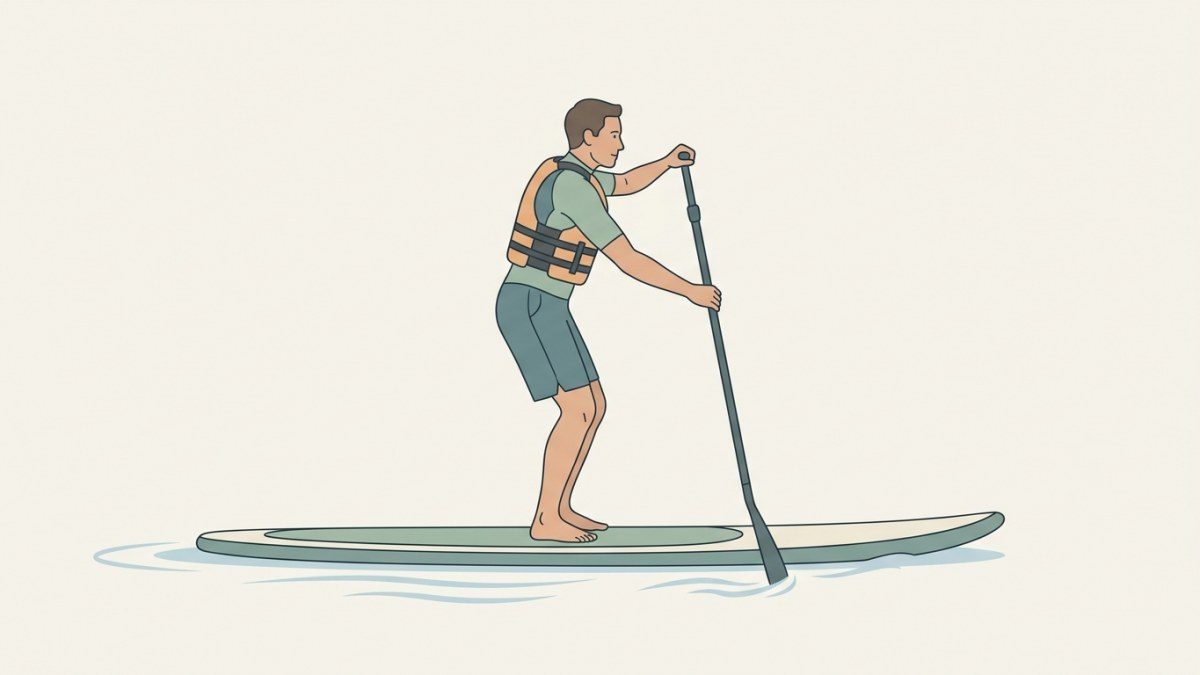
As a quick check, hold the paddle horizontally over your head, and your elbows should form roughly right angles.
How to Stand Up
Start in calm water that's at least knee-deep, so the fin clears the bottom. Then follow these steps:
- Kneel on the board just behind the carry handle in the middle, which marks the board's balance point.
- Paddle a few strokes from your knees. A board with a little forward motion feels steadier.
- Lay the paddle across the deck under your hands and place your palms flat on the board.
- Bring one foot, then the other, to where your knees were, feet about hip-width apart on either side of the handle.
- Rise slowly with your knees bent and your back straight, lifting the paddle as you come up.
- Look at the horizon, not your feet. Your balance follows your eyes.
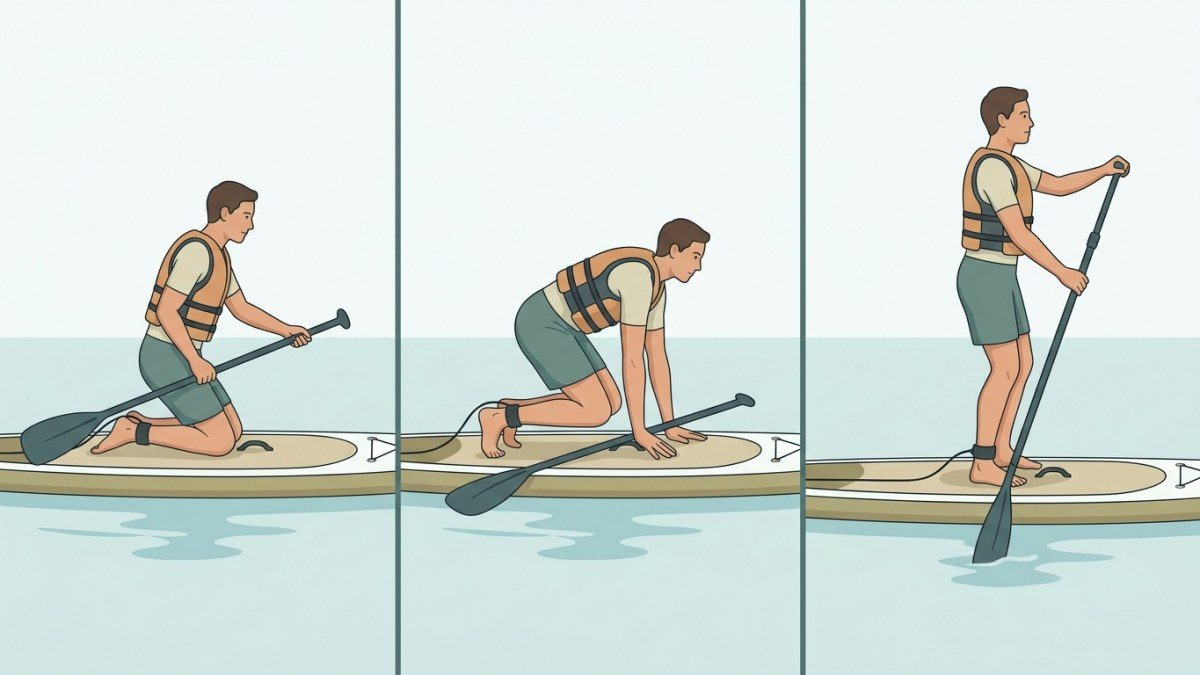
Once you're up, keep your feet parallel and pointing forward,
knees soft and weight centered. Let your hips absorb the wobble while your upper body stays quiet.
If a wake or gust unsettles you, drop back to your knees; there's no shame in it.
Basic Strokes
Forward stroke. Reach forward,
plant the whole blade in the water and pull it back alongside the board to about your ankle,
then lift it out. Power comes from your core and hips as much as your arms.
The more vertical the shaft, the straighter you'll travel, so take several strokes on one side, then switch.
Sweep stroke. To turn,
place the blade near the nose and sweep it in a wide arc out to the side and back toward the tail.
The board turns away from the side you're sweeping on.
Bending your knees a little helps you stay balanced as the board pivots.
Reverse stroke. Place the blade in the water behind you and push it forward to slow down, stop or back up.
It's also a quick way to turn in tight spaces.
Falling and Climbing Back On
Everyone falls, so plan to fall well.
Aim to the side, away from the board, and land flat in the water rather than on the deck or the fin.
In shallow water, fall as flat as possible and never dive.
To climb back on, put the paddle on the deck,
move to the side of the board near the center handle,
grab the handle and kick your legs up to the surface behind you.
Slide your chest onto the board, then pull yourself into a kneeling position before standing again.
If you're tired or cold, simply paddle to shore on your knees.
Where to Go for Your First Session
Pick a small, sheltered lake or calm bay with light wind and few boats.
Standing up, your body acts like a sail, so even a moderate breeze can push you around.
Avoid wind blowing from shore toward open water, stay close to the shoreline and head into the wind first so it helps you home.
If the wind picks up, kneel or even lie down and paddle to reduce how much it catches you.
An introductory lesson is well worth it, and many rental shops offer one.
You'll learn on the right equipment, in suitable conditions, with someone watching your technique.
Common First-Day Mistakes
Nearly everyone makes a few of these on day one, and each has an easy fix:
- Looking down at your feet. It pulls your weight forward and makes the board feel less stable.
- Standing with locked knees. Stiff legs pass every wobble straight up to your shoulders.
- Holding the paddle backward. Check that the blade angles toward the nose of the board.
- Paddling with arms only. Hinge at the hips and use your core, and you'll last much longer.
- Heading out downwind. The return trip can be far harder than the way out.
- Staying out too long. Balance fades as you tire, so end the session while it's still fun.
Frequently Asked Questions
How long does it take to learn?
On calm water, many people are standing and paddling within their first hour or two.
Feeling relaxed in wind, chop and boat wakes takes more practice, which is why short, frequent sessions help.
Is it a good workout?
It can be as gentle or as demanding as you make it.
An easy cruise works your balance and core, while longer, faster sessions become real endurance exercise.
Can I bring my dog or a child?
Get comfortable on your own first. When you're ready, start on calm water close to shore,
make sure your passenger wears a properly fitted flotation device made for them and keep sessions short.
Enjoy the View From Your Board
Stand-up paddleboarding rewards patience more than strength.
Choose a wide board, calm water and a light breeze, wear your life jacket and leash, and let yourself fall a few times.
Before long you'll be gliding along the shoreline, looking down at fish and weeds drifting beneath your feet.
Sources and Further Reading
This article was reviewed by the BraverPlay editorial team against the official sources below. Rules, conditions and gear vary from place to place, so always check the latest guidance from local authorities before you head out.
- Paddlecraft (Including Stand Up Paddleboarding), Oregon State Marine Board: Paddleboards count as boats under Coast Guard rules, so life jacket and whistle requirements apply; dress for immersion.
- Choosing Lifejackets and Personal Flotation Devices (PFDs), Transport Canada: Stand-up paddleboards used for trips are vessels that must carry an approved lifejacket or PFD; a leash is no substitute.
- On the Water at Last!, U.S. National Park Service: Choose the right type of leash for the water you'll paddle, and check the water temperature, since you may need a wetsuit.
- Common Paddling Hazards, National Center for Cold Water Safety: Offshore wind is a common paddling hazard that can blow paddlers away from shore.