
Anúncios
Every stretch of water is constantly showing you what it's doing.
A smooth V pointing downstream marks the clearest path through a riffle,
a patch of darker ripples hints at a gust racing toward you,
Anúncios
and waves rebounding off a seawall warn of confused water ahead.
Paddlers who learn to read these signs spend less energy and avoid many unpleasant surprises.
Here's how to read river currents, spot serious hazards, judge wind and handle waves and tides,
so you can make better decisions before and during every trip.
How River Current Behaves
Current isn't uniform. It's usually fastest near the middle of the river and just below the surface,
and slowest along the banks and the bottom, where friction holds it back.
On a bend, the fastest water swings to the outside, where it tends to push boats toward the bank,
undercut the soil and collect fallen trees.
The inside of a bend is usually slower and shallower, often with a gravel bar.
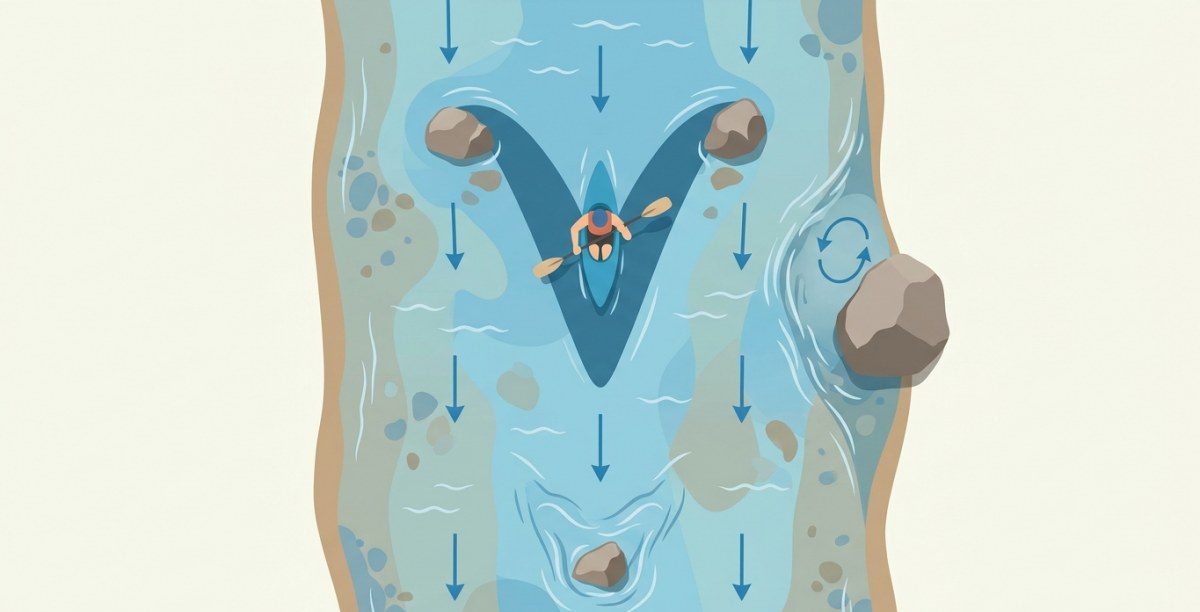
Watch for V shapes on the surface.
A V pointing downstream usually marks a smooth tongue of deeper water between two obstacles, often the best route.
A V pointing upstream usually means a rock or other obstacle sits at its tip, just below the surface, so steer around it.
Water level changes everything.
A river that's a gentle float at normal levels can become fast and pushy after rain, with eddies washed out and trees in the water.
Muddy water, floating debris and a waterline creeping up the banks all suggest the river is rising.
Eddies and Other Features
Behind rocks, bridge piers and points of land, water circles back upstream or goes slack, forming an eddy.
Eddies are the paddler's rest stops, useful for pausing, regrouping or looking downstream.
The seam where the main current meets the eddy, called the eddy line, can be sharp and swirly,
and crossing it carelessly is a common way to tip over.
Other features worth recognizing include pillows, the smooth mound of water piling against the upstream face of a rock,
and boils, patches of water welling up from below that can nudge your boat unpredictably.
Crossing eddy lines and handling these features with control are core parts of moving-water instruction.
River Hazards You Must Recognize
Some features aren't obstacles to navigate; they're places to avoid entirely.
- Strainers: Fallen trees, branches, fences or debris that let water flow through but catch boats and people. They're among the most dangerous hazards on any river and are often found on the outside of bends. Give them a very wide berth.
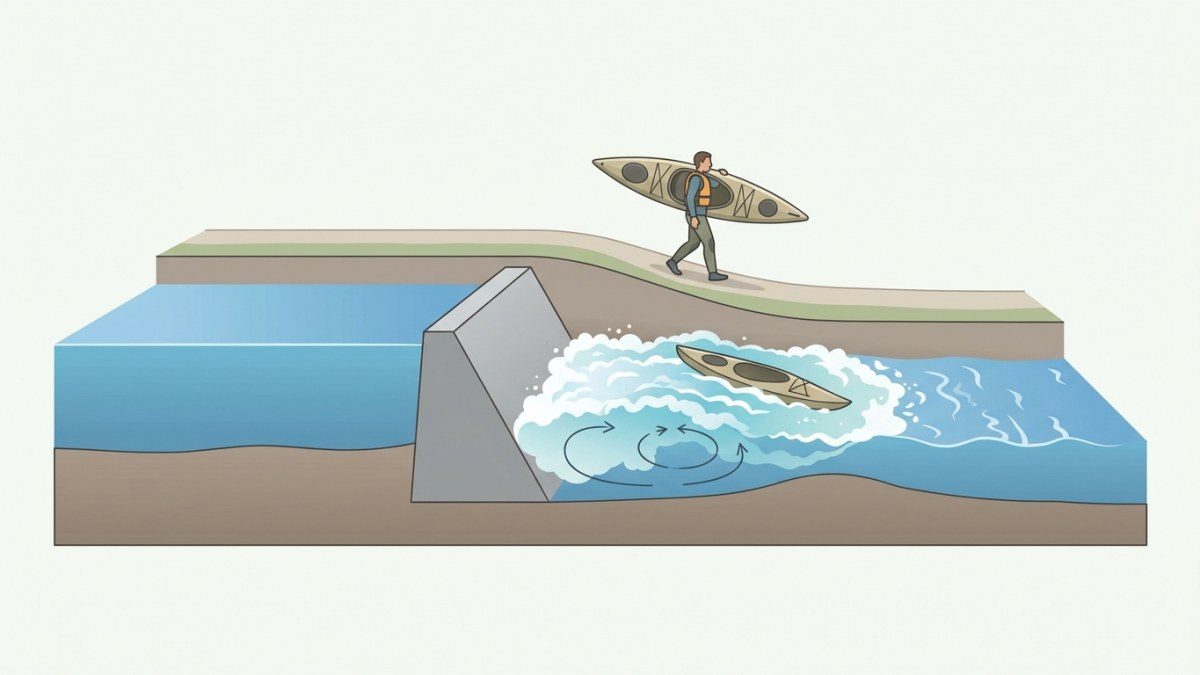
- Low-head dams and weirs: These uniform drops across a river create a recirculating current at the base that can hold a boat or swimmer. They can look harmless from upstream. Never paddle over one; get out well upstream and carry around.
- Horizon lines: A line across the river where the water seems to disappear means a drop. Get to shore well above it and scout or portage.
- Undercut rocks and sieves: Water can flow under or between rocks in ways that trap anything swept into them.
- High, fast water: After heavy rain or snowmelt, rivers rise, speed up, grow colder and carry debris. Flooded rivers are no place for recreational paddling.
If you end up swimming in current, float on your back with your feet downstream and at the surface to fend off rocks.
Don't try to stand up in fast-moving water more than knee-deep, because a foot wedged between rocks can hold you under.
Wind: The Force You Can't See
On lakes and open water, wind often matters more than current.
It pushes your boat, builds waves and can turn a calm outing into a struggle surprisingly quickly.
Check the forecast for both speed and direction, and remember that on many lakes and coasts, wind tends to build through the afternoon.
Read the water for wind, too. Dark, rippled patches moving across the surface are gusts on their way to you,
and whitecaps signal conditions that are becoming too rough for most beginners.
Tall cliffs, valleys and gaps between hills can funnel wind into strong, sudden gusts.
Offshore wind, blowing from land out toward open water, deserves special caution.
The water near shore looks calm because it's sheltered, while conditions farther out are rougher, and every stroke home becomes a fight.
Plan to paddle into the wind on the way out so it helps you on the way back,
and use islands, points and shorelines for shelter.
Waves, Wakes and Rebounding Water
Wind waves grow with the strength of the wind,
how long it has been blowing and the distance of open water it blows across, known as the fetch.
That's why the far side of a big lake can be much rougher than your sheltered launch.
Local wind chop tends to be steep and closely spaced,
while swell that has traveled from far away is longer and smoother,
though it can still break hard on shallow reefs and points.
Boat wakes often arrive some time after the boat has passed. Turn your bow or stern to meet them at an angle rather than letting them strike your side,
keep paddling for stability and let your hips stay loose so the boat can move beneath you.
Near cliffs, seawalls and steep rocky shores, waves bounce back and collide with incoming ones, creating confused, choppy water.
Stay a comfortable distance off these features in anything but calm conditions.
Breaking surf along beaches is its own discipline, and launching or landing through it takes training.
Tides and Tidal Currents
On the coast, the water level rises and falls with the tides, about twice a day in many places,
and that movement drives tidal currents through bays, inlets, channels and around headlands.
These currents can be strong enough to overpower a paddler, especially where water squeezes through a narrow gap.
Tidal currents are often weakest around the turn of the tide and strongest in between,
but the timing of slack current doesn't always match high and low water.
Tide predictions tell you the height of the water, while current predictions, where available,
tell you the speed and direction of the flow, so use both.
Plan to travel with the current where you can and be particularly careful where an outgoing current runs against the wind or incoming waves,
which stacks up steep, dangerous seas.
Turning Observation Into Good Decisions
Reading water is only useful if it changes what you do.
Before launching, spend a few minutes on shore looking at the water, the sky and the treetops.
On a river, check the water level from a gauge report or local source and compare it with what's recommended for your route.
When you can't see what's around a bend or over a drop, get out and scout.
When in doubt, walk around.
Skills like ferrying across current and choosing a line through rapids are best learned in whitewater and moving-water courses,
where instructors can show you the water from the safety of an eddy.
On lakes and coasts, favor routes that follow a sheltered shoreline and save open crossings for the calmest part of the day.
Keep reassessing as you go. When the waves start to feel bigger than your skills,
turn back or head for the nearest sheltered landing before conditions make the choice for you.
Keep Watching the Water
Reading water is a skill you'll keep sharpening for as long as you paddle.
Start by noticing the basics, the Vs, eddies, gusts and wakes, and before long you'll anticipate them.
Pair that awareness with the humility to scout, portage or stay on shore when conditions look wrong,
and you'll enjoy far more good days on the water.
Sources and Further Reading
This article was reviewed by the BraverPlay editorial team against the official sources below. Rules, conditions and gear vary from place to place, so always check the latest guidance from local authorities before you head out.
- River Safety: Upper Delaware Scenic and Recreational River, U.S. National Park Service: Watch for strainers and sweepers, float on your back with feet downstream, and don't stand in rapids, to avoid foot entrapment.
- Lowhead Dams, Virginia Department of Wildlife Resources: Low-head dams hide a recirculating current, are hard to spot from upstream, show a horizon line and should always be portaged.
- Common Paddling Hazards, National Center for Cold Water Safety: Offshore wind, wind against current, reflected waves and strainers are among the most common paddling hazards.
- Waves (JetStream Online Weather School), NOAA: Wave size depends on wind strength, how long it blows and the fetch, and swell can travel far from where it formed.
- Tides and Currents: Frequently Asked Questions, NOAA Tides & Currents: Slack water often doesn't coincide with high and low tide, so tide and current predictions must be checked separately.