
Anúncios
The first few minutes in a kayak usually feel a little wobbly.
Then the boat settles, the shoreline starts sliding past and you realize you're moving across the water under your own power.
Kayaking is one of the most approachable paddle sports, and you don't need to be an athlete or own any gear to try it.
Anúncios
Below you'll find everything a first outing needs: where to go, which boat to use, what to wear,
how to hold the paddle and how to handle the moments that make beginners nervous.
Read it once before you go, and your first trip will feel far less like guesswork.
Choose Calm Water and a Calm Day
Where you paddle matters more than anything else on day one.
Look for a small lake, a sheltered pond or a slow, flat stretch of river with no rapids,
little boat traffic and an easy launch, such as a gently sloping beach or a low dock.
Save open coastlines, big lakes and fast rivers for later.
Wind is the condition that catches most beginners off guard.
Even a moderate breeze can raise small waves and make steering tiring, so check the forecast and aim for light winds.
On many lakes the air is calmest early in the day, with wind building as the afternoon warms up.
Be especially wary of wind blowing from the shore out toward open water.
It makes the trip out feel effortless and the trip back a real fight.
A simple habit solves this: start by heading into the wind, so the ride home has the wind at your back.
If you can, rent from an outfitter on calm water or join an introductory lesson or guided tour.
You'll get a boat and life jacket that fit, a quick briefing on the basics and someone nearby who knows the area.
Pick a Stable, Forgiving Kayak
For a first outing, a recreational kayak is the easiest choice.
These boats are wide, stable and fairly short, usually around 9 to 12 feet,
which makes them easy to turn and hard to tip on flat water. You'll see two main styles:
- Sit-on-top kayaks have an open, molded deck that you sit on. They drain through small holes called scuppers, and if you slide off, you can climb back on. In warm water they're the most forgiving option.
- Sit-inside kayaks have a cockpit you slide your legs into. They keep you drier and a bit warmer, and recreational models have large cockpits that are easy to get in and out of.
Tandem kayaks hold two people and feel very stable, but they reward teamwork.
The paddler in the back steers and matches the rhythm of the person in front, which keeps the blades from clashing.
Before you launch, adjust the seat back so it supports you upright,
then set the foot braces so your knees are slightly bent and your feet press gently against them.
That contact is what lets you control the boat with your body instead of just your arms.
What to Wear and Bring
Always wear a life jacket, buckled and snug, whenever you're on the water.
Choose one approved by your country's authority, such as the U.S. Coast Guard in the United States, and wear it rather than stowing it behind the seat.
Capsizes happen in a second, and there's rarely time to put one on in the water.
Dress for the temperature of the water, not the air. Sudden immersion in cold water triggers cold-water shock,
an involuntary gasp and rapid breathing that can make even strong swimmers inhale water,
and it can happen on a warm, sunny day.
For a first outing, choose warm water and fair weather; paddling on cold water calls for a wetsuit or drysuit and proper training.
In warm conditions, wear quick-drying synthetic or wool clothing and skip cotton, which stays wet and chilly.
Add a sun hat, sunglasses on a strap and secure footwear such as water shoes or sandals with heel straps.
Then pack a small bag with:
- Drinking water and a snack
- Sunscreen and lip balm
- A whistle clipped to your life jacket
- Your phone in a waterproof case
- A spare warm layer sealed in a dry bag
Hold the Paddle the Right Way
A surprising number of beginners hold the paddle upside down or backward. Check two things.
First, the scooped, concave face of each blade should face you so it grips the water as you pull.
Second, many blades are asymmetrical, and the shorter edge belongs on the bottom.
Place your hands a little wider than your shoulders.
A quick check is to rest the shaft on top of your head: your elbows should bend to roughly right angles.
Line up your knuckles with the top edge of the blade and keep your grip relaxed, with loose fingers rather than a tight fist.
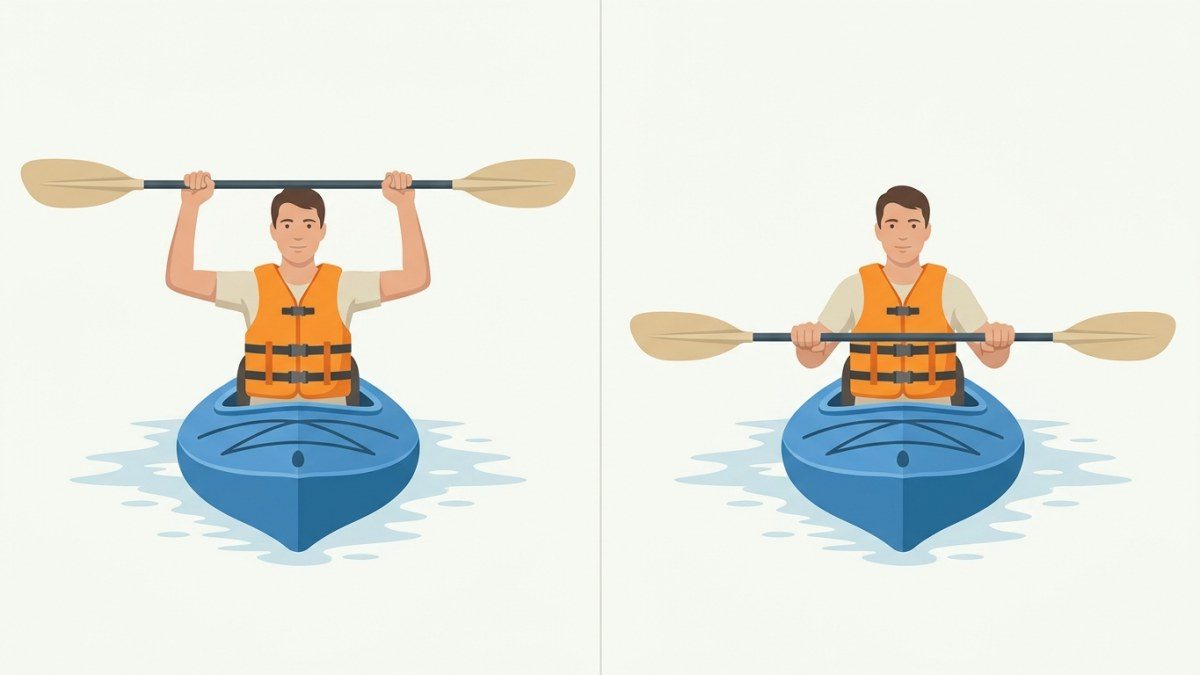
Some paddles let you rotate the blades so they sit at an angle to each other, which is called feathering.
For your first day, set them in line with each other. It's simpler, and you can experiment later.
Your First Strokes
The forward stroke does most of the work, and good technique saves your arms.
Sit tall, rotate your torso and place the blade in the water near your feet.
Pull it back along the side of the kayak until it reaches your hip, then lift it out and repeat on the other side.
Think about turning your upper body to move the paddle rather than pulling with your arms.
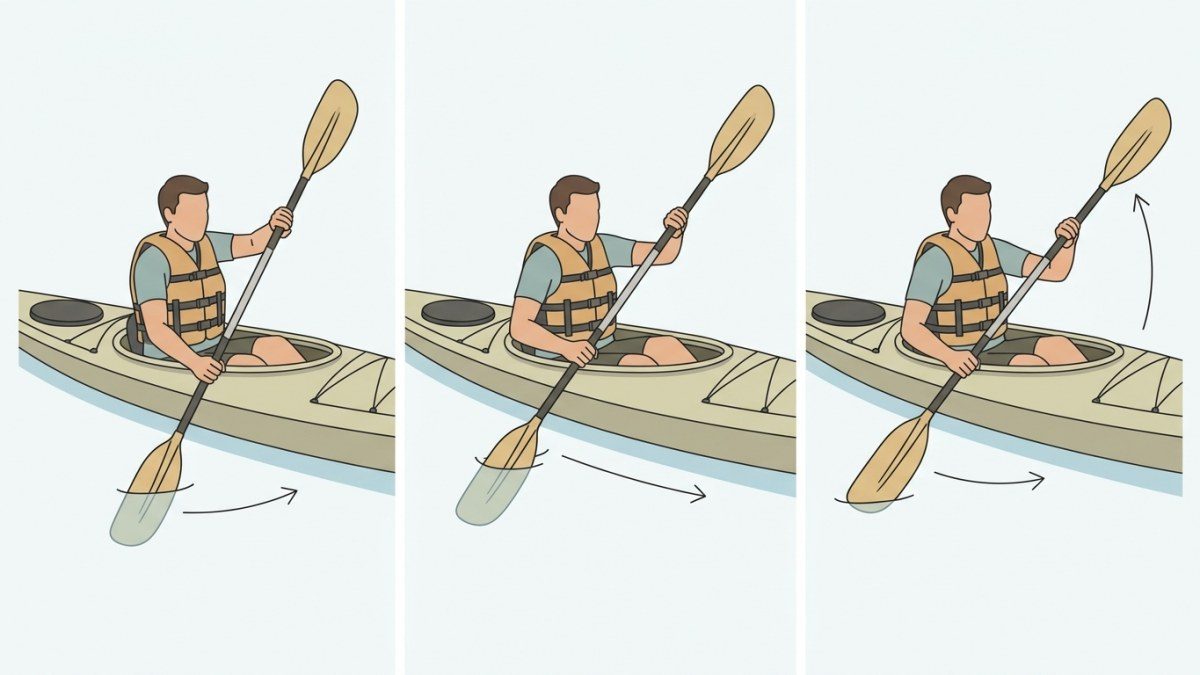
Three more moves will get you through a first trip:
- Reverse stroke: Push the blade forward from behind your hip to slow down, stop or back up.
- Sweep stroke: Trace a wide arc from the front of the boat toward the back on one side to turn toward the opposite side.
- Small corrections: If the kayak zigzags, shorten your strokes, keep them close to the hull and fix your eyes on a point ahead.
Expect some wandering at first.
Recreational kayaks turn easily, which is great for maneuvering and less great for holding a line, but even,
relaxed strokes on both sides straighten things out quickly.
Simple Habits That Keep You Safe
Stay close to shore on your first outing, in water where you'd be comfortable if you ended up swimming.
Keep your weight low and centered, and avoid leaning far over the side.
Sudden weight shifts, like lunging for a dropped hat, are a classic way to tip over on flat water.
Plan a short trip, around an hour, and turn back while you still feel fresh,
since the return takes as much energy as the way out.
Paddle with a friend, tell someone where you're going and when you'll be back, and wear bright colors so other boaters can see you.
Give powerboats plenty of room, because from their helm a low kayak can be hard to spot.
If a wake rolls toward you, turn your bow to meet it at an angle instead of letting it hit you from the side.
Frequently Asked Questions
Do I need to be a strong swimmer?
You don't need to be a strong swimmer to paddle calm water,
but you should be comfortable in the water and always wear a properly fitted life jacket.
If you can't swim, tell your guide or instructor, stay close to shore and consider swimming lessons.
What happens if I tip over?
Stay calm, keep hold of your paddle and hold on to the kayak, which floats and is easy to see.
On a sit-on-top, you can flip it upright and climb back on from the side; with a sit-inside,
you'll usually swim it to shore to empty it.
Practicing in warm, shallow water with an instructor takes the fear out of it.
Will I be sore afterward?
Many beginners feel it in their shoulders, forearms and hands, usually from gripping too hard and paddling with their arms alone.
Relaxing your grip and rotating your torso with each stroke spreads the effort to bigger muscles, and a short first trip keeps soreness mild.
Ready to Push Off
A first kayak trip doesn't need to be long or adventurous to be a success.
Calm water, a stable boat, a life jacket you actually wear and an hour of easy paddling are all it takes.
Build from there one skill at a time, and take a rescue and self-rescue course before you venture onto bigger or colder water.
Sources and Further Reading
This article was reviewed by the BraverPlay editorial team against the official sources below. Rules, conditions and gear vary from place to place, so always check the latest guidance from local authorities before you head out.
- Life Jacket Wear / Wearing Your Life Jacket, U.S. Coast Guard Boating Safety: Choosing a Coast Guard-approved life jacket and wearing it snug and buckled; most boating drownings happen unexpectedly, often on nice days.
- Cold Shock, National Center for Cold Water Safety: Sudden immersion triggers an involuntary gasp and rapid breathing that can make even strong swimmers inhale water.
- Cold Water Hazards and Safety, National Weather Service (NOAA): Dress for the water temperature, not the air; the gasp reflex can be triggered even by water as warm as 77°F (25°C).
- Paddlecraft (Including Stand Up Paddleboarding), Oregon State Marine Board: Start on calm, flat water, keep your weight low and centered, and turn your bow into boat wakes instead of taking them broadside.
- Paddle Safety, NSW Government (Transport for NSW): Stay close to shore, tell someone your plans, wear bright colors and stay with your craft if you capsize.